A healthcare company spent nine months building a comprehensive data governance strategy. They hired consultants. They documented 247 policies. They created a detailed org chart with data stewards, data owners, and governance councils.
Three months after launch, the strategy was dead. Nobody followed the policies. Data stewards couldn't explain their role. The governance council stopped meeting. Total investment: $340K. Total impact: Zero.
Their competitor took a different approach. They started with one painful problem: patient data that didn't match across systems. Fixed that in six weeks. Then tackled the next problem. Twelve months later, they had working governance that teams actually followed.
Same goal. Different approach. One failed because it was too comprehensive. One succeeded because it was ruthlessly focused.
Why Most Data Governance Strategies Die Within 90 Days
Most companies think data governance strategy means creating comprehensive documentation: policies for every scenario, org charts with clear roles, technology platforms cataloging everything, processes covering all situations.
That's not strategy. That's theater.
Enterprise data governance strategy solves specific problems that hurt your business today. It starts small, proves value fast, then expands. It focuses on adoption over completeness. It measures outcomes, not documentation.
A financial services firm learned this the expensive way. They spent $280K with data governance consulting companies building what looked like a perfect strategy — detailed framework, clear accountability, comprehensive policies, technology platform selected.
Launch day came. Week one: confusion about who approves what. Week four: data stewards overwhelmed by requests they couldn't handle. Week eight: teams reverting to old workarounds because the new process was slower. Week twelve: leadership questioning the investment.
The problem wasn't expertise. It was trying to govern everything at once instead of solving real problems incrementally.
The 7-Step Data Governance Strategy Framework
Step 1: Identify the Problem Costing Real Money (Week 1)
Don't start with "we need data governance." Start with "this data problem is costing us $X monthly and we can't continue."
A retail company began their data governance implementation strategy by asking: "What's our most expensive data problem?" The answer: inventory data quality so poor that stores had phantom stock, causing missed sales and frustrated customers. Cost: $180K monthly in lost revenue. That became their starting point — not comprehensive governance, but solving the $180K inventory problem.
Ask three questions to find your starting point:
- Where is bad data costing real money? Look for missed revenue, compliance fines, operational waste, bad decisions based on wrong data. Quantify the cost. "Bad data quality" is vague. "$180K monthly lost sales from phantom inventory" is specific.
- Where are compliance gaps creating real risk? Failed audits, regulatory warnings, data breaches waiting to happen. What's the potential fine or business impact?
- Where are teams wasting hours because they can't find or trust data? Marketing can't segment customers. Finance can't close books on time. Sales can't forecast accurately. Time wasted has dollar value.
Pick the problem that hurts most and has executive attention. That's your starting point for data governance strategy.
Step 2: Prove Value in 6–8 Weeks, Not 6–8 Months (Weeks 2–8)
The retail company didn't try to govern all inventory data. They picked one product category: electronics — the most expensive, with the highest phantom stock rate and biggest revenue impact.
- Week 2: Documented current state — how inventory data flows from suppliers to systems to stores, where quality breaks, who touches it.
- Weeks 3–4: Fixed the most obvious quality issues. Standardized supplier data formats. Added validation at entry points. Corrected known phantom stock.
- Weeks 5–6: Established simple governance. One person owns electronics inventory data quality. Weekly quality checks. Clear escalation when issues appear.
- Weeks 7–8: Measured impact. Phantom stock in electronics down 73%. Lost sales reduced by $48K in those two weeks alone.
That success funded expansion — next category, then the next. Within six months, governance covered all high-value inventory. Teams bought in because they saw results, not because policy said so.
The lesson: Prove governance works before scaling it. Six weeks showing $48K impact beats six months of planning with zero results.
Step 3: Define Governance That Fits Your Culture (Weeks 9–10)
Most data governance strategies fail because they impose the wrong culture on the wrong organization.
A pharmaceutical company made this mistake. They copied a tech company's governance framework: autonomous data product teams, decentralized ownership, minimal oversight. Beautiful in theory. Disaster in practice. Regulated pharma can't operate like unregulated tech.
Instead, design governance matching your culture:
- Conservative, regulated industries need clear approval chains, documented decisions, audit trails. Build governance with controls built in, not bolted on later.
- Fast-moving companies need governance that doesn't slow decisions. Automate approvals. Build quality checks into pipelines. Enable teams, don't gate them.
- Hybrid environments need both — clear controls for regulated data, lightweight processes for everything else.
Ask: "What governance would we actually follow?" Not "What do data governance best practices say?" Best practice that doesn't fit your culture becomes shelf-ware.
Step 4: Start With Policies People Will Actually Follow (Weeks 11–12)
A manufacturing company created 89 data governance policies. Covered every scenario imaginable. Took three months to write. Nobody read them.
Their competitor created three policies:
- Customer data can't leave approved systems without explicit approval.
- Production data quality issues escalate to the production manager within 1 hour.
- New data sources require quality validation before use.
Three policies. Everyone understood them. Teams actually followed them.
When building your data governance strategy, create policies that pass three tests:
- Can someone explain the policy in one sentence? If it takes a paragraph, it's too complex.
- Can someone follow it without asking IT? If every policy requires technical intervention, you've created bottlenecks.
- Does it solve a real problem we have? Policies preventing problems you don't have waste attention.
Start with 3–5 critical policies. Add more only when those are working. Twenty policies nobody follows accomplish less than three policies everyone follows.
Step 5: Assign Ownership That Actually Works (Weeks 13–14)
Most data governance frameworks create roles disconnected from daily work — a data steward who doesn't touch the data, a data owner who doesn't use the data, a governance council that meets monthly to discuss problems others experience daily.
A logistics company rebuilt governance around people who actually work with the data:
- Customer data owner: Head of Customer Success (uses data daily, understands business context)
- Supply chain data owner: VP Operations (depends on data quality for decisions)
- Financial data owner: Controller (responsible for data accuracy in reporting)
These weren't ceremonial roles. These people already cared about data quality because bad data hurt their results.
Make ownership real by asking: "Who hurts when this data is wrong?" That person should own governance, not someone who's organizationally convenient but operationally disconnected.
Add one critical rule: owners can delegate tasks but not accountability. When your bonus depends on data quality, you govern it.
Step 6: Choose Technology That Enables, Not Complicates (Weeks 15–16)
Data governance consulting companies often lead with technology. "You need a governance platform. Spend $200K." Sometimes true. Often premature.
A healthcare company bought a $180K governance platform before they knew what they were governing. They used 11% of features. The rest was complexity they didn't need.
Start with what you have:
- Week one of governance: A spreadsheet tracking data quality issues works fine.
- Month two: A simple database tracking policies and ownership works fine.
- Month four: When spreadsheets become painful, then buy purpose-built tools.
Technology should solve problems you're experiencing, not problems you might have someday. When you do need a platform, choose based on adoption likelihood — the best governance technology disappears into existing workflows. The worst requires new workflows nobody adopts.
Step 7: Measure What Actually Matters (Weeks 17–18 and Ongoing)
Most data governance strategies measure governance activity: policies created, stewards appointed, meetings held, data cataloged. Those are inputs, not outcomes.
A financial services firm tracked governance this way:
- Data quality improved: Customer data match rate between systems went from 67% to 94% in six months.
- Compliance improved: Audit findings reduced from 23 to 4.
- Efficiency improved: Time to find and trust data went from 4 hours to 20 minutes.
- Revenue protected: $380K in potential fines prevented through better data controls.
Build your data governance strategy measurement around three categories:
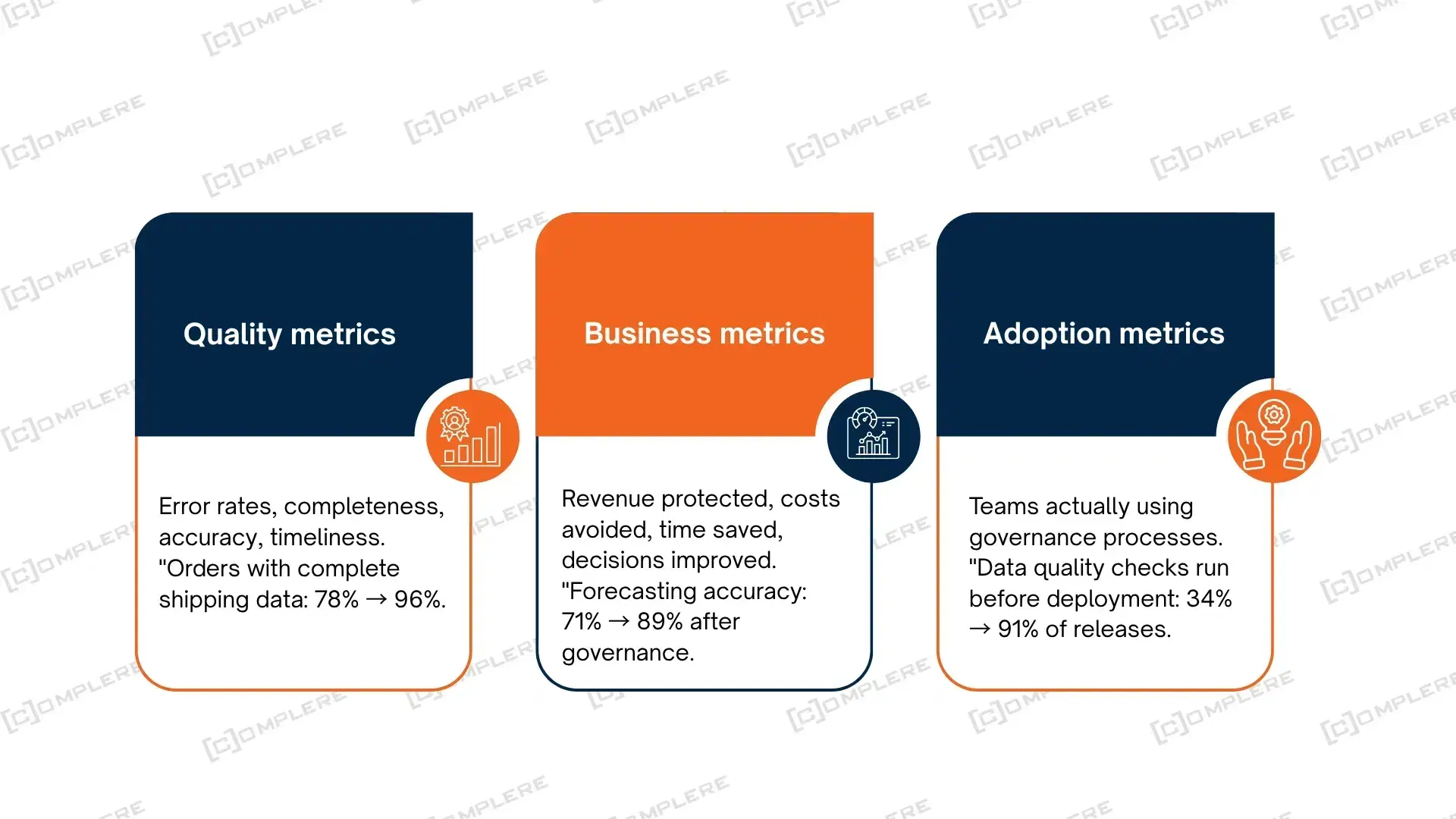
- Quality metrics: Error rates, completeness, accuracy, timeliness. (e.g., "Orders with complete shipping data: 78% → 96%")
- Business metrics: Revenue protected, costs avoided, time saved, decisions improved. (e.g., "Forecasting accuracy: 71% → 89% after governance")
- Adoption metrics: Teams actually using governance processes. (e.g., "Data quality checks run before deployment: 34% → 91% of releases")
Report these monthly to leadership. When governance shows measurable business impact, funding and support follow.
What Success Looks Like at 6 Months
A manufacturing company followed these seven steps starting January 2025:
- Month 1: Identified phantom inventory as a $180K monthly problem. Fixed electronics category. Saved $48K in two weeks.
- Month 2: Expanded to three more high-value categories. Defined governance fitting their culture: clear ownership, weekly quality reviews, escalation protocols.
- Month 3: Created five critical policies everyone understood and followed. Assigned ownership to people who actually used the data.
- Month 4: Implemented simple technology — quality dashboard, automated checks, Slack alerts for issues.
- Month 5: Governance covering 80% of revenue-critical data. Quality improvements showing in business metrics.
Month 6 Results:
- Phantom inventory down 81% across all categories
- Lost sales reduced by $127K monthly
- Inventory accuracy from 73% to 96%
- Compliance audit findings: 0 (was 7)
- Team adoption: 88% (they wanted governance because it worked)
- Total investment: $85K (mostly internal time). ROI: Positive within eight weeks.
When to Call Data Governance Consulting Companies
Most companies don't need consultants to start. The seven steps above work without external help. But consultants add value in specific scenarios:
- You're in heavily regulated industries (healthcare, finance) where compliance complexity is high.
- You're implementing governance across 40+ countries with different data privacy laws.
- You've tried governance twice and failed both times — outside perspective reveals blind spots internal teams miss.
- Your leadership needs external validation to fund governance properly.
But don't hire consultants to avoid doing the work. Consultants can't make teams adopt governance. They can't define your problems better than you can. They can't make hard organizational decisions about ownership. Use them for expertise gaps, not as outsourced governance.
Conclusion
Data governance strategy in 2026 isn't about comprehensive frameworks deployed all at once. It's about solving real problems incrementally, proving value continuously, and expanding based on success.
Start with one painful problem. Fix it in six weeks. Measure the impact. Use that success to fund the next problem. Within six months, you have working governance that teams follow because it helps them, not because policy requires it.
The companies succeeding with data governance don't have the most comprehensive strategies. They have strategies that work: focused, proven, adopted, and measured.
Need a data governance strategy that actually works? Book a free consultation for your data governance strategy assessment today.