Every organization today sits on mountains of data, but the real question isn't whether you have data—it's whether you're using the right approach to extract value from it. Business intelligence vs data analytics is a critical decision that impacts your technology stack, team structure, budget allocation, and ultimately, your competitive advantage.
If you're a business leader, CTO, or data strategy decision-maker wrestling with this choice, you're not alone. The confusion stems from genuine overlap between these disciplines, but understanding their distinct purposes can save your organization from costly misalignment between tools and business objectives.
Let's break down what each approach offers, when to deploy which solution, and how to make the right investment for your specific business context.
Understanding Business Intelligence:
Business intelligence (BI) is your organization's rearview mirror and real-time speedometer combined. It focuses on transforming historical and current data into actionable reports, dashboards, and visualizations that answer: "What happened?" and "What's happening now?"
Core BI functions include:
- Creating standardized reports for consistent business monitoring
- Building interactive dashboards for executive decision-making
- Tracking KPIs across departments and business units
- Generating automated alerts when metrics hit predefined thresholds
- Providing self-service analytics for non-technical business users
Think of BI as your operational command center. When your CFO needs quarterly revenue breakdowns by region, when your sales director wants conversion rates across channels, or when operations needs supply chain visibility—that's business intelligence territory.
Common BI tools: Power BI, Tableau, Looker, Qlik Sense, Google Data Studio
The strength of BI lies in democratizing data access. Well-implemented BI platforms let marketing managers, finance teams, and operations staff answer their own questions without waiting for data teams to run custom queries.
What Is Data Analytics with Example Details:
Data analytics takes a fundamentally different approach. Rather than monitoring established metrics, it explores data to uncover patterns, test hypotheses, and predict future outcomes. Data analytics answers: "Why did this happen?" and "What will happen next?"
What is data analytics with example? Consider an e-commerce company noticing declining sales. BI tells them sales dropped 15% last quarter. Data analytics investigates why—discovering that customers abandoning carts correlate with a recent checkout page redesign, specific product categories showing higher abandonment on mobile devices, and predictive models suggesting which customers are likely to churn next month.
Core analytics capabilities:
- Root cause analysis to understand why metrics changed
- Customer segmentation based on behavioral patterns
- Predictive modeling for forecasting and risk assessment
- A/B testing and statistical experimentation
- Advanced machine learning for complex pattern recognition
Data analytics requires deeper technical expertise—data scientists and analysts comfortable with statistical methods, programming languages like Python or R, and machine learning frameworks.
Common analytics tools: Python (pandas, scikit-learn), R, Apache Spark, SAS, MATLAB
Business Intelligence vs Data Analytics:
Understanding business intelligence vs data analytics becomes clearer when you examine five critical dimensions:
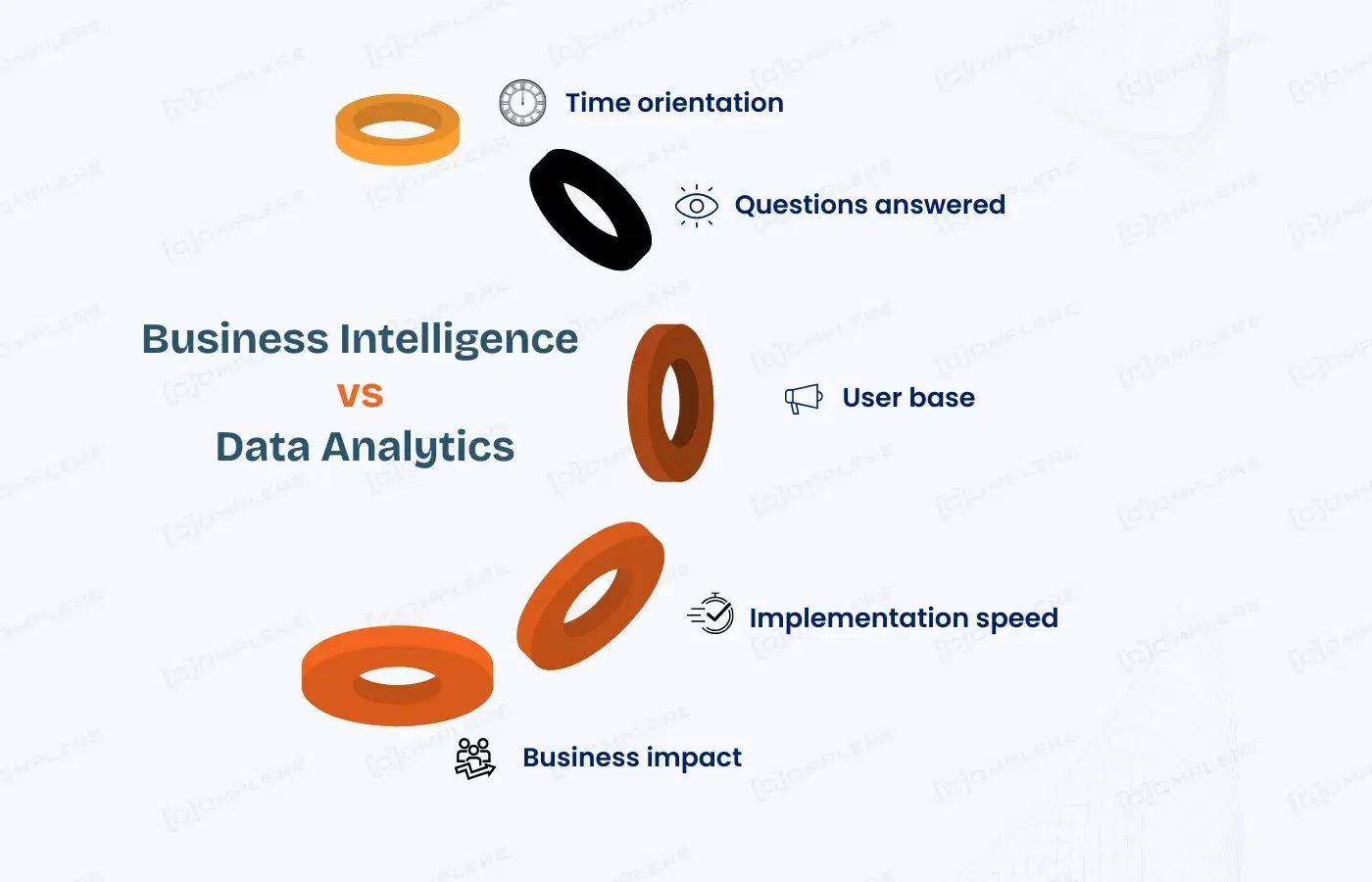
- Time orientation: BI focuses on what already happened or is currently happening. Analytics extends into predicting what will happen and prescribing what should happen next.
- Questions answered: BI excels at descriptive questions with known metrics. Analytics tackles exploratory questions requiring investigation and modeling.
- User base: BI serves business users across the organization who need insights without technical expertise. Analytics serves specialized analysts and data scientists conducting deep investigations.
- Implementation speed: BI delivers faster time-to-value for standard reporting needs. Analytics requires more time for exploration, model development, and validation.
- Business impact: BI optimizes existing operations through monitoring and quick course corrections. Analytics identifies new opportunities and strategic shifts through discovery.
Neither approach is inherently superior—they serve different but complementary business needs.
Data Management Tools for Analytics:
Before choosing between BI and analytics, recognize both require solid data management infrastructure. Your data management tools for analytics determine whether either approach can deliver value.
Essential data management components:
- Data warehouses (Snowflake, Google BigQuery, Amazon Redshift) consolidate data from multiple sources into a single source of truth. Without this foundation, both BI and analytics produce inconsistent, unreliable results.
- ETL/ELT pipelines (Fivetran, Airbyte, Azure Data Factory) automate data movement and transformation, ensuring fresh, clean data reaches your analytics platforms.
- Data catalogs (Alation, Collibra) provide metadata management, making it easier for both BI users and data analysts to discover and understand available datasets.
- Data quality tools monitor accuracy, completeness, and consistency—critical for trustworthy BI reports and reliable analytics models.
- Organizations often underinvest in data management while overinvesting in analytics tools, then wonder why insights don't materialize. Your data infrastructure needs to come first.
Which Solution Does Your Business Actually Need?
The answer for most organizations isn't either/or—it's both, but in the right sequence and proportions.
Start with BI if you:
- Lack visibility into basic business performance metrics
- Need to democratize data access across departments
- Have clear KPIs but inconsistent reporting
- Want quick wins and stakeholder buy-in for data initiatives
- Have limited data science expertise in-house
Prioritize analytics when you:
- Already have solid BI infrastructure and monitoring
- Face complex business problems requiring investigation
- Need predictive capabilities for planning and forecasting
- Have access to data science talent or partners
- Operate in rapidly changing markets requiring proactive insights
Realistic implementation pathway: Most successful organizations follow this progression: establish data management foundations → implement BI for operational visibility → layer analytics for strategic insights → continuously refine both.
ROI Considerations: Making the Business Case
Business intelligence typically shows ROI faster—often within 3-6 months—through improved operational efficiency, reduced reporting overhead, and better tactical decisions.
Data analytics ROI takes longer to materialize but can be transformative: identifying new revenue streams, predicting customer churn before it happens, optimizing pricing strategies, or forecasting demand with greater accuracy.
Budget allocation wisdom suggests 60-70% toward BI and data management for organizations building data capabilities, shifting to 40-60% once foundational BI is mature and strategic analytics becomes the differentiator.
Implementation Realities: Common Pitfalls to Avoid
- Don't buy tools before defining use cases: The most expensive mistake is implementing enterprise BI or analytics platforms without clear business problems to solve.
- Don't underestimate change management: Technology is 30% of the challenge; getting people to actually use insights is 70%.
- Don't skip data governance: Without clear data ownership, quality standards, and security protocols, both BI and analytics produce garbage.
- Don't ignore integration.: Your BI and analytics solutions must integrate with existing systems—CRM, ERP, marketing automation—or they'll create data silos instead of breaking them down.
Conclusion:
The business intelligence vs data analytics question ultimately comes down to organizational maturity and business objectives. BI provides the operational backbone every data-driven organization needs—consistent metrics, accessible insights, and performance monitoring. Data analytics builds that foundation to drive innovation, predict outcomes, and identify opportunities invisible in standard reports.
For most businesses, the winning strategy is sequential investment: nail the fundamentals with solid data management and BI first, then expand into advanced analytics as your data maturity grows. This approach delivers quick wins while building toward transformative capabilities.
The organizations winning with data aren't choosing between BI and analytics—they're strategically deploying both to create competitive advantages their rivals can't match.
Need expert guidance on implementing the right data analytics or business intelligence solution? Let's discuss your data strategy—contact us today.