When pipelines break, numbers don't match, and teams can't trust dashboards; you lose time, revenue, and decision speed. This isn't just a technical issue—it's a data engineering tools utilization and execution problem that affects your entire organization.
This guide covers what actually works in 2026: analytics infrastructure, pipeline architecture, and platform strategy decisions that directly impact your bottom line. You'll also learn when enterprise data engineering consulting or data engineering outsourcing makes sense—and when it doesn't.
The quick test: If two leaders ask "What is revenue?" and get different answers, you have a data engineering problem, not a dashboard problem.
An Overview on Data Engineering Tools:
Data engineering tools are specialized software that automate moving, transforming, and monitoring data across systems—replacing manual processes that break at scale. Without them, your teams spend weeks building what should take days, pipelines fail silently, and data quality issues reach executives before engineers even know there's a problem.
What Data Engineering Actually Means in 2026
Data engineering is the work of moving data from scattered systems into one trusted, usable layer—so analytics, AI, and reporting run on consistent inputs.
Includes: ingestion, transformation, orchestration, quality validation, security, observability, and governance.
The output? Reliable datasets that your business can actually trust and act on.
Data Science VS Data Engineering: Quick Clarity
Leaders often confuse these roles. Here's the distinction:
Data Engineering builds the reliable infrastructure: pipelines, data models, access controls, monitoring systems, and trusted datasets.
Data Science builds the analysis layer: predictions, experiments, ML models, and insights that use those datasets.
The reality: It isn't about choosing one. Data science can't scale without strong data engineering foundations, and data engineering needs business context to define what "correct" means. They're complementary, not competitive.
Decision Checklist (Use This Before Buying)
Before evaluating any data engineering tools, answer these first:
- Workload type: Batch, streaming, or both?
- Cloud platform: AWS, Azure, GCP, hybrid, multi-cloud?
- Data destinations: Snowflake, BigQuery, Databricks lakehouse, Postgres?
- Regulation level: Healthcare/finance or less restricted?
- Operating model: Internal team, data engineering outsourcing, or consulting support?
- Non-negotiables: Lineage tracking, access controls, monitoring, recovery time?
- 2026 requirements: AI/ML workloads, real-time needs, privacy engineering?
Match your answers to the tools below.
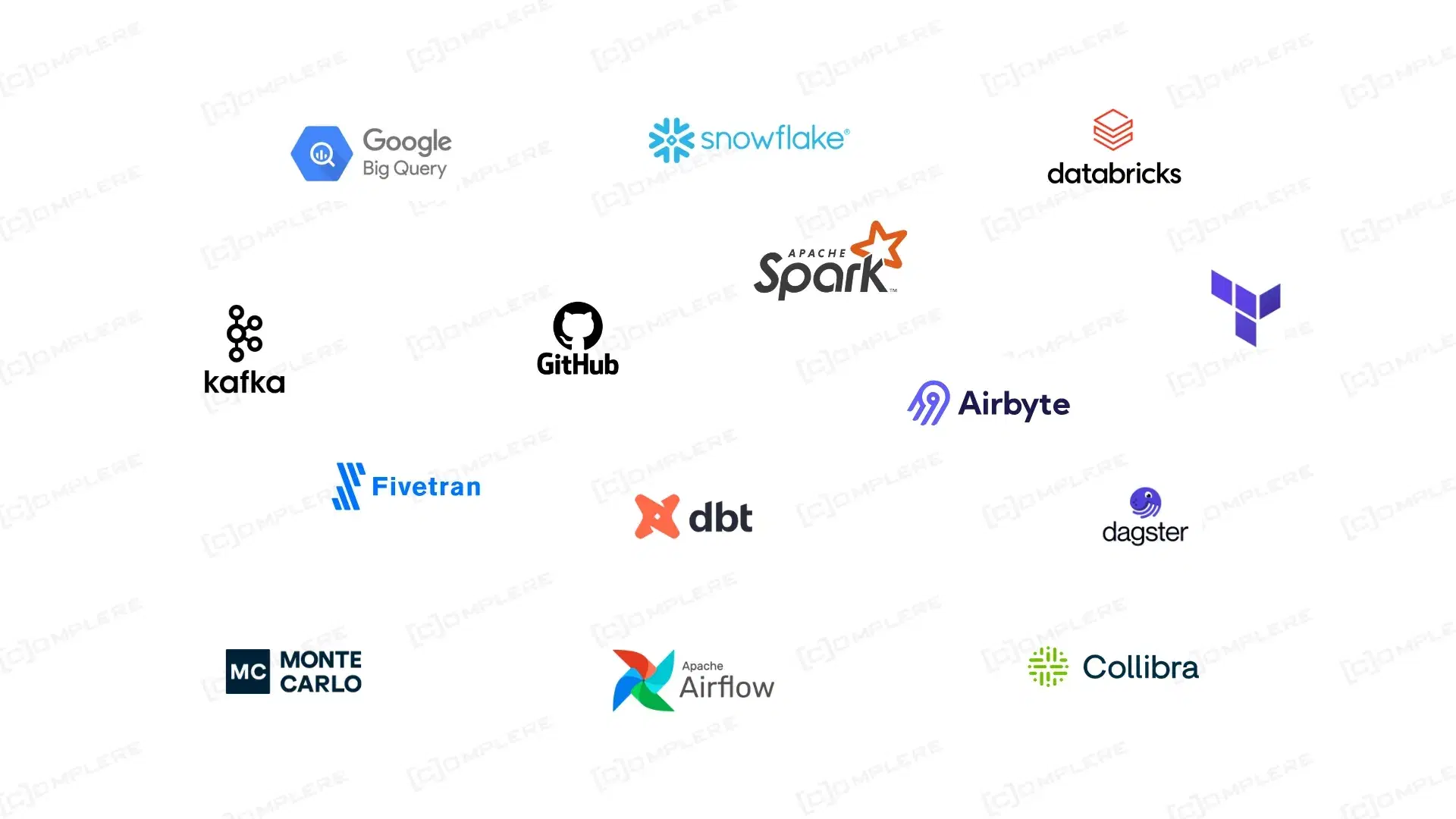
The 15 Data Engineering Tools (Organized by Function)
Core Data Platforms
1) Snowflake (Cloud Data Warehouse)
Best for: Governed analytics at scale, cost visibility, strong performance with proper modeling.
Reality check: Treat it like infrastructure—cost controls, query standards, and ownership matter. Without warehouse sizing rules and monitoring, costs spiral fast.
When to choose: Multi-cloud flexibility and enterprise governance are priorities.
2) Google BigQuery (Cloud Warehouse)
Best for: Fast analytics, tight GCP integration, strong performance for large workloads.
Key advantage: Pay-per-query pricing can beat Snowflake for sporadic usage. Serverless means zero warehouse management overhead.
Snowflake vs BigQuery: BigQuery wins on GCP ecosystems and serverless simplicity. Snowflake wins on multi-cloud support and advanced features.
3) Databricks (Lakehouse Platform)
Best for: Unified analytics + ML workflows, Spark-native scaling, lakehouse architecture.
Why it matters for data engineering: Combines warehouse performance with data lake flexibility. One platform for both analysts and data scientists.
Choose when: You need analytics and heavy ML collaboration in one environment.
Compute & Processing
4) Apache Spark (Distributed Compute Engine)
Core capability: Large-scale transformations, complex data preparation, parallel processing.
Spark powers: Databricks and many managed services—it's the engine behind modern data engineering at scale.
Streaming & Real-Time
5) Apache Kafka (Event Streaming Backbone)
Use case: Real-time pipelines, event streaming, operational analytics.
Honest truth: Real-time infrastructure is only valuable if your business can act in real-time. Don't build streaming for batch use cases.
Ingestion Tools
6) Fivetran (Managed Ingestion)
Strength: Fast, stable connectors from 400+ SaaS sources into warehouses.
Cost reality: You pay for convenience in data engineering—monitor usage carefully. Can get expensive at scale.
7) Airbyte (Flexible Open-Source Ingestion)
Best for: Teams wanting more control, customization, and connector flexibility.
Trade-off: Lower cost, higher engineering effort. Good when you have in-house data engineering capacity.
Orchestration & Workflow
8) Apache Airflow (Workflow Orchestration)
Capability: Scheduling, dependency management, production pipeline monitoring.
Strong Airflow setup reduces "hero work" and late-night data engineering fires. Industry standard for complex DAGs.
9) Dagster (Modern Orchestration)
Why it's different: Developer-friendly, clearer asset definitions, better testing support.
Airflow vs Dagster: Airflow for mature, battle-tested workflows. Dagster for maintainability and modern data engineering experience.
Transformation & Analytics Engineering
10) dbt (SQL Transformation Framework)
Core value: Standardized transformations, built-in testing, documentation, version control.
Has become the standard for analytics engineering. Improves speed and trust when teams agree on metric definitions.
Infrastructure & Deployment
11) Terraform (Infrastructure as Code)
Purpose: Repeatable cloud setups, controlled environments, less manual drift.
Critical for scaling data engineering safely across teams and regions. Version-controlled infrastructure prevents configuration chaos.
12) GitHub Actions (CI/CD for Data Pipelines)
Function: Automated testing, deployment, change control for pipelines and dbt models.
Reduces the "someone changed something and now finance reports are wrong" problem in data engineering operations.
Data Quality & Observability
13) Great Expectations (Data Quality Testing)
Role: Validate data before it hits dashboards or ML training.
Quality checks protect decision credibility. Catches data engineering issues upstream before they become executive problems.
14) Monte Carlo (Data Observability Platform)
Capability: Detects breaks, anomalies, freshness issues, and upstream impact quickly.
Observability is the difference between "minutes to detect" vs "days to detect" in data engineering incidents.
Governance & Catalogs
15) Collibra (Enterprise Data Catalog + Governance)
Focus: Governance, metadata management, definitions, stewardship, audit readiness.
Governance done right is a speed tool for data engineering—reduces confusion and rework across teams.
What's Actually New for Data Engineering in 2026
1. AI-Native Data Platforms
Vector databases like Pinecone, Weaviate, Qdrant are now essential for LLM applications. Traditional warehouses don't handle embedding search well.
2. Reverse ETL Tools
Hightouch, Census push warehouse data back into operational systems (Salesforce, HubSpot). Closes the loop from analytics to action.
3. Data Privacy Engineering
Tools like OneTrust, BigID handle automated PII detection, consent management, and compliance—critical as regulations tighten globally.
4. Real-Time Data Mesh Architectures
Domain-oriented ownership with federated governance. Tools like Starburst, Dremio enable distributed query across domains.
5. FinOps for Data
Vantage, CloudZero provide granular cost tracking by team, pipeline, and query—essential when cloud spend hits seven figures.
Tool Comparison: Quick Reference
| Category | Tool | Best For | Learning Curve |
|---|---|---|---|
| Warehouse | Snowflake | Multi-cloud, governance | Medium |
| Warehouse | BigQuery | GCP-native, serverless | Low |
| Lakehouse | Databricks | Analytics + ML unified | High |
| Orchestration | Airflow | Complex DAGs, mature | High |
| Orchestration | Dagster | Modern dev experience | Medium |
| Ingestion | Fivetran | Managed, fast setup | Low |
| Ingestion | Airbyte | Customization, open-source | Medium |
| Quality | Great Expectations | Testing, validation | Medium |
| Observability | Monte Carlo | Anomaly detection | Low |
When Enterprise Data Engineering Consulting Makes Sense
Enterprise data engineering consulting is worth considering when you need outcomes faster than hiring and training will allow.
Common scenarios:
Pipeline stabilization – Production systems breaking frequently
Standard KPI definitions – Different departments getting different numbers
Platform migrations – Moving to Snowflake, Databricks, or lakehouse architecture
Governance design – Building operating models and data quality frameworks
Cost optimization – Reducing cloud spend by 30-50% without sacrificing performance
Standard KPI definitions – Different departments getting different numbers
Platform migrations – Moving to Snowflake, Databricks, or lakehouse architecture
Governance design – Building operating models and data quality frameworks
Cost optimization – Reducing cloud spend by 30-50% without sacrificing performance
Good enterprise consulting partners leave behind repeatable patterns, documentation, and trained internal owners—not just temporary fixes.
When Data Engineering Outsourcing Works (And When It Fails)
works well for clearly scoped, measurable work:
Platform migrations with defined endpoints
Connector builds and integration projects
Standard data models and pipeline templates
Monitoring and observability setup
Connector builds and integration projects
Standard data models and pipeline templates
Monitoring and observability setup
Data engineering outsourcing fails when:
Data engineering outsourcing cements change weekly
Ownership and accountability are unclear
Success metrics aren't defined upfront
Teams expect outsourcing to replace strategic decisions
Ownership and accountability are unclear
Success metrics aren't defined upfront
Teams expect outsourcing to replace strategic decisions
If you choose data engineering outsourcing, insist on: SLAs, code ownership clarity, comprehensive documentation, and handover plans with knowledge transfer.
Conclusion
Data engineering in 2026 isn't just about tools—it's about architecture, ownership, and standards that enable your business to move faster with confidence.
The right approach combines proven platforms (Snowflake, Databricks, BigQuery) with modern capabilities (vector databases, reverse ETL, privacy engineering) and strong operational practices (testing, observability, cost controls).
Success in data engineering comes from:
- Clear ownership and accountability across teams
- Standardized definitions that eliminate confusion
- Quality checks before production deployment
- Cost visibility and control mechanisms
- Governance that enables speed, not slows it down
Whether you build internal teams, partner with enterprise data engineering consulting firms, or use data engineering outsourcing for specific projects, the foundation stays the same: trusted data that teams can act on confidently.
This debate misses the point—you need both working together on solid infrastructure.
Book Your Free 20-Minute Stack Review– we'll show you exactly where your data engineering should start.