A decade ago financial services organizations debated whether to invest in data. Today the debate is about whether their data engineering is keeping pace with what the business needs from it.
The gap between organizations that have engineered clean, governed, and scalable data pipelines and those that are still managing data through manual processes and fragmented systems is widening. The firms on the right side of that gap are processing transactions faster, meeting compliance obligations with less effort, serving customers more accurately, and making risk decisions with more confidence. The firms on the wrong side are spending their engineering resource firefighting the same pipeline problems repeatedly.
Data engineering is the discipline that determines which side of that gap a financial services organization sits on. This blog covers seven data engineering in financial services examples that are driving measurable transformation right now and what building toward each one actually requires.
Why Financial Services Data Engineering Is at an Inflection Point
Financial services organizations have always generated data at scale. What has changed is the expectation of what that data should deliver and how quickly.
Real time transaction demands, regulatory scrutiny across multiple frameworks, AI driven risk models, and customer experience expectations have all arrived in a compressed window. Each one requires data engineering foundations that most organizations built neither for this volume nor for this velocity.
The organizations responding well are the ones treating their data engineering roadmap as a strategic priority rather than a technology project. They are mapping which pipelines need to exist, what quality standards each one must meet, and in which sequence the infrastructure should be built to deliver the highest business value earliest. The ones struggling are the ones treating each new requirement as a separate project rather than a layer on a shared foundation.
Seven Data Engineering Use Cases Transforming Financial Services
Each use case below is drawn directly from genuine financial services operational requirements and represents a data engineering in financial services example where organizations are seeing measurable transformation in how the business operates.
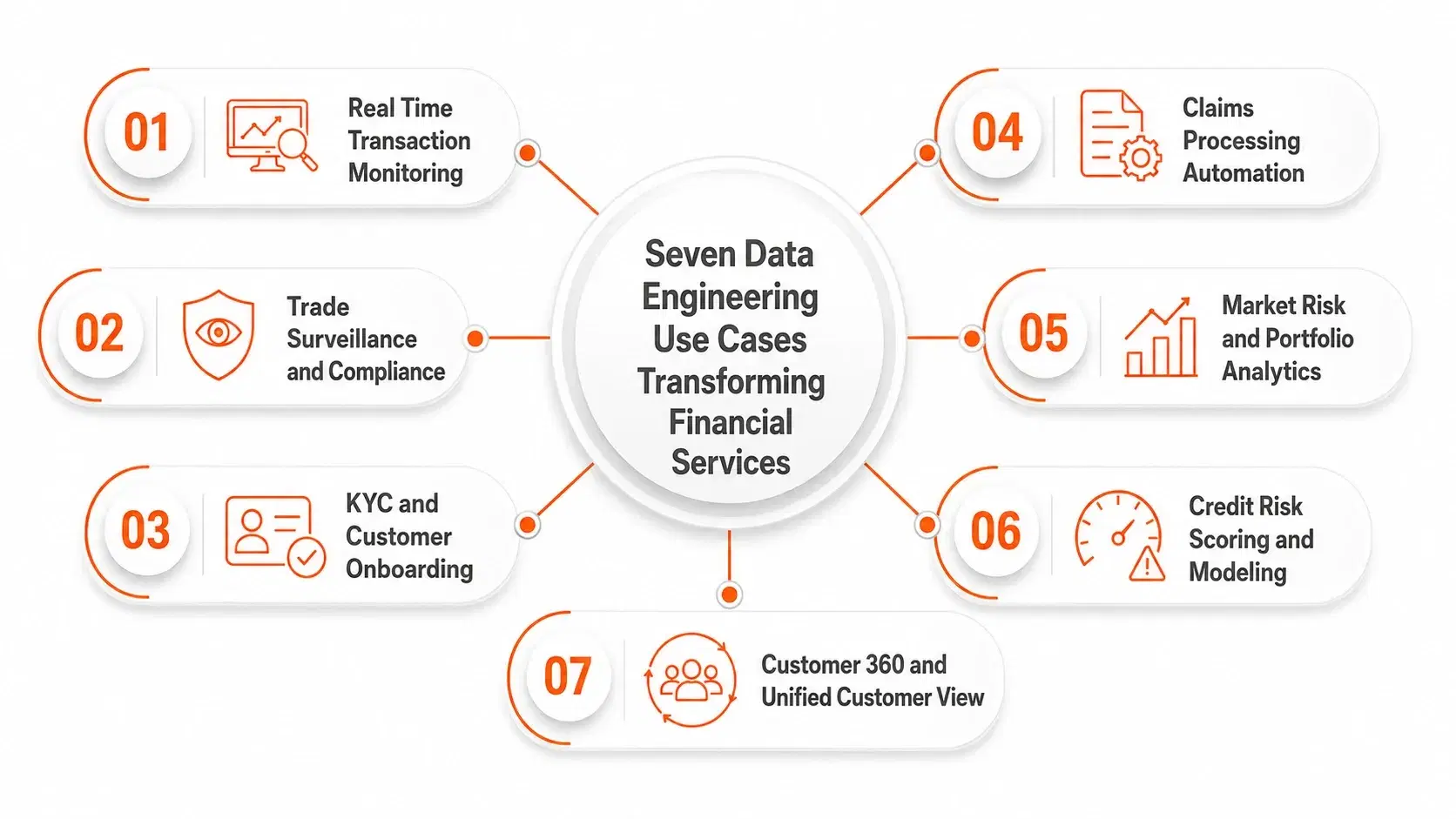
Use Case 1 — Real Time Transaction Monitoring
Financial institutions process millions of transactions daily across payment networks, mobile channels, ATMs, and branch systems. Monitoring these transactions for anomalies, fraud signals, and regulatory triggers in real time requires data engineering pipelines that ingest, enrich, and evaluate each transaction within milliseconds of it occurring.
The data engineering challenge is building a pipeline that maintains accuracy and completeness at this velocity without introducing latency that affects the customer experience. Raw transaction data must be ingested from multiple channels simultaneously, enriched with customer history and behavioral context, and delivered to monitoring models with full data lineage maintained throughout. Organizations that have built this infrastructure correctly detect issues at the point of transaction rather than discovering them in overnight batch reports when remediation is significantly more expensive.
Use Case 2 — Trade Surveillance and Compliance
Capital markets firms operate under strict obligations to monitor trading activity for market manipulation, insider trading signals, and best execution failures. Trade surveillance requires data engineering pipelines that ingest order data, execution data, market data feeds, and communication records from multiple systems and make them queryable together in near real time.
The engineering complexity here is significant. Trade data arrives from order management systems, execution venues, and prime brokers in different formats and at different latencies. Communication records require separate ingestion and linkage to relevant trades. And the combined dataset must be stored with the full audit trail and retention requirements that regulators mandate. Data engineering consulting firms that build trade surveillance infrastructure must design for both the analytical performance compliance teams need and the regulatory defensibility the institution requires.
Use Case 3 — KYC and Customer Onboarding
Know your customer processes require financial institutions to verify customer identity against government databases, sanction lists, adverse media sources, and beneficial ownership registries before onboarding. The data arrives from dozens of external sources in different formats with different update cycles and must be matched against internal customer records with a level of accuracy that satisfies regulatory examination.
Data engineering as a service applied to KYC builds the ingestion, normalisation, and matching pipelines that replace manual compliance workflows with governed automated processes. The result is faster customer onboarding, lower cost per KYC review, and a more defensible audit trail. The Financial Action Task Force guidance on digital identity provides the international standard that KYC data engineering must be designed to support from the architecture stage forward.
Use Case 4 — Claims Processing Automation
Insurance claims processing depends on accurate data flows between customer records, policy systems, assessment tools, fraud detection models, and payment engines. In most insurance organizations this flow is partially manual introducing delays and errors that increase claims cycle time and operational cost in ways that compound across high volumes.
Data analytics engineering services applied to claims processing replace fragmented manual workflows with governed automated pipelines. Customer data, policy terms, loss assessment outcomes, and payment instructions move through the same engineered pipeline with validation at each stage. Claims cycle time reduces measurably. The data produced by the pipeline simultaneously feeds the fraud detection and assessment automation that improves accuracy over time. Both operational efficiency and model performance improve from the same engineering investment.
Data analytics engineering services applied to claims processing replace fragmented manual workflows with governed automated pipelines. Customer data, policy terms, loss assessment outcomes, and payment instructions move through the same engineered pipeline with validation at each stage. Claims cycle time reduces measurably. The data produced by the pipeline simultaneously feeds the fraud detection and assessment automation that improves accuracy over time. Both operational efficiency and model performance improve from the same engineering investment.
Use Case 5 — Market Risk and Portfolio Analytics
Investment management firms and trading desks require data engineering infrastructure that aggregates position data, market data feeds, valuation inputs, and risk factor updates into a consistent and current view of portfolio risk across all asset classes. The accuracy and latency requirements of this infrastructure directly affect the quality of risk management decisions and the accuracy of regulatory capital calculations.
Big data engineering services applied to market risk and portfolio analytics rebuild the ingestion and aggregation pipelines that feed risk models with clean, current, and consistently formatted inputs. Position data from multiple trading systems, market data from multiple vendors, and valuation models from multiple platforms are all brought together through engineered pipelines that eliminate the manual reconciliation and data quality failures that compromise risk calculations when the infrastructure beneath them is not properly engineered.
Use Case 6 — Credit Risk Scoring and Modeling
Credit risk models in financial services are only as accurate as the data engineering pipelines that feed them. Bureau data, internal transaction history, application data, behavioral signals, and macroeconomic indicators must all flow through governed, validated pipelines before reaching the model that produces a credit score or a lending decision.
Data engineering service and solutions providers for credit risk focus on three pipeline layers. The ingestion layer that pulls from bureau APIs, internal systems, and alternative data sources consistently and completely. The transformation layer that engineers the features the model requires from raw inputs. And the serving layer that delivers the right feature values to the right model at the right point in the decision process. When any of these layers is poorly engineered the model produces scores that do not reflect actual credit risk regardless of how sophisticated the algorithm is.
Use Case 7 — Customer 360 and Unified Customer View
Financial services customers hold current accounts, savings products, loans, insurance policies, and investment products that typically exist in separate core systems with separate customer records. A customer holding five products with the same institution may exist as five separate and unlinked records across those systems.
Data integration engineering services that build a unified customer view across all of these systems create the foundation for personalised product recommendations, accurate risk assessment, and regulatory compliance across the full customer relationship. The engineering challenge is handling the variety of data formats, identifier conventions, and update frequencies across different product platforms while maintaining the data quality and lineage standards that financial regulation demands. Institutions that complete this engineering investment report measurable improvements in cross sell conversion, customer retention, and regulatory examination outcomes.
Building Toward These Use Cases: The Data Engineering Roadmap
Organizations that try to implement all seven of these use cases simultaneously consistently underdeliver on every one of them. The ones that succeed build a data engineering roadmap that sequences the use cases by dependency and business value.
The sequencing logic is consistent across most financial services organizations. Foundation layer work comes first — unified customer data, governed pipeline standards, and cloud infrastructure. Use cases that generate measurable cost savings or risk reduction come next because they produce the business case for continued investment. Analytics and AI driven use cases come last because they depend on the clean governed data that the earlier layers produce.
When evaluating data engineering consulting services and data engineering service and solutions providers for financial services work look for four things specifically. Deep experience with financial services regulatory frameworks not just general data engineering capability. A roadmap methodology that sequences use cases by dependency not just by stakeholder demand. A governance first approach that builds audit logging, lineage tracking, and access control into every pipeline from the start. And reference engagements from financial institutions of comparable size and complexity that demonstrate delivery not just design.
When evaluating data engineering consulting services and data engineering service and solutions providers for financial services work look for four things specifically. Deep experience with financial services regulatory frameworks not just general data engineering capability. A roadmap methodology that sequences use cases by dependency not just by stakeholder demand. A governance first approach that builds audit logging, lineage tracking, and access control into every pipeline from the start. And reference engagements from financial institutions of comparable size and complexity that demonstrate delivery not just design.
Conclusion
The financial services organizations transforming their operations through data engineering are not doing so by implementing the most advanced technology. They are doing so by engineering clean, governed, and reliable data pipelines that give every function in the business the data it needs when it needs it.
The seven use cases in this blog are not a destination. They are a sequence. Each one builds on the engineering foundation established by the one before it. Organizations that understand this and build their data engineering roadmap accordingly are the ones consistently widening the gap between themselves and the competition.
The seven use cases in this blog are not a destination. They are a sequence. Each one builds on the engineering foundation established by the one before it. Organizations that understand this and build their data engineering roadmap accordingly are the ones consistently widening the gap between themselves and the competition.
Build compliant, scalable data engineering for financial services. Schedule a free demo today.