Running a business in 2026 means your data is everywhere CRM, billing, marketing tools, product events, spreadsheets, apps, partner systems. The problem isn’t that you don’t have data. The problem is that you can’t trust it, combine it fast, or use it to make decisions without debate.
That’s exactly where data warehouse consulting helps. Good warehouse consultants don’t just “build a warehouse.” They design a decision-ready system: reliable pipelines, clean models, governed access, and a structure that makes reporting and AI initiatives easier—not harder.
This guide covers what it is, why it matters now, what such Warehouse Consulting Companies actually deliver, how to pick the right partner, and a practical comparison to help you choose the right approach.
What Is a Data Warehouse in 2026?
A data warehouse is a centralized system designed for analytics—reporting, dashboards, KPI tracking, forecasting, and decision-making. Unlike operational databases (built to run the business), a warehouse is built to understand the business.
In 2026, warehouses are often cloud-first and built around platforms like Snowflake, Databricks, Google Cloud (with BigQuery), Amazon Web Services (with Amazon Redshift), and Microsoft Azure (with Azure Synapse Analytics).
What Is Data Warehouse Consulting?
Data warehouse consulting is the professional service of planning, designing, implementing, and optimizing your data warehouse so it supports real business outcomes.
A strong consulting engagement typically includes:
- Understanding business decisions (not just “requirements”)
- Designing the architecture and data model
- Building ingestion + transformation pipelines
- Defining governance, security, and data quality
- Enabling self-serve analytics and performance at scale
- Training your team + setting up operating rhythms
Think of it as building a “decision factory,” not a storage project.
Why Modern Analytics Break Without a Warehouse
A lot of companies try to run analytics off raw systems or half-built pipelines. It “works” until it doesn’t.
Here’s what usually breaks first:
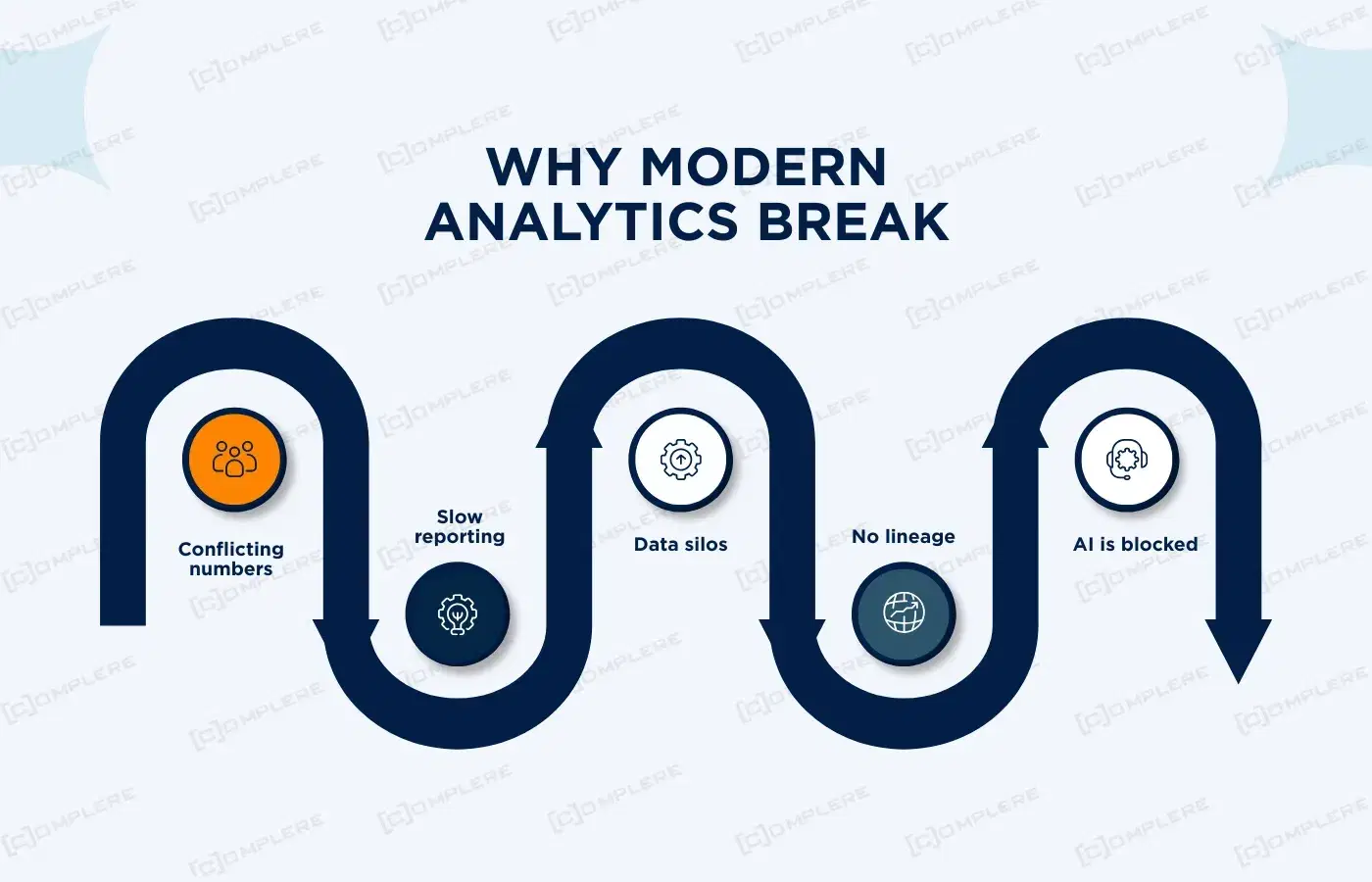
- Conflicting numbers: “Revenue” is calculated 4 different ways
- Slow reporting: every dashboard takes days to update or validate
- Data silos: marketing can’t connect to product usage, finance can’t reconcile ops
- No lineage: nobody can explain where a metric came from
- AI is blocked: models need consistent, governed, historical data
A warehouse fixes this by creating a shared, validated foundation—so people stop arguing about numbers and start acting on them.
What Data Warehouse Consulting Delivers in 2026
Modern data warehouse consultants typically deliver these capabilities:
A) KPI and semantic layer design
Not just tables—definitions. One version of truth for core metrics.
B) Ingestion and pipeline engineering
Batch + near real-time ingestion, with monitoring and alerting (so issues are caught before stakeholders do).
C) Transformation and modeling
Clean, standardized models using tools like dbt and orchestration with Apache Airflow.
D) Data quality framework
Automated checks (freshness, completeness, duplicates, schema drift) tied to SLAs.
E) Performance + cost optimization
Partitioning, clustering, query optimization, workload isolation, right-sizing—so you don’t pay for chaos.
F) Security + governance
Role-based access, PII controls, auditability, and environment separation.
G) Analytics enablement
Clean datasets, curated marts, and BI-ready structures so dashboards don’t become a permanent engineering dependency.
Key Benefits of Hiring Data Warehouse Consultants
Here’s what you’re really buying when you hire a consulting partner:
- Speed with correctness: less trial-and-error, fewer rewrites
- Architecture that survives growth: new sources and teams don’t break the system
- Better trust in metrics: faster decisions, fewer “data debates”
- Lower total cost: fewer hotfixes, cleaner pipelines, optimized compute
- Reusable foundations: adding new dashboards becomes easier over time
Key Components of Data Warehouse Architecture
A high-performing warehouse is more than “a database.”
A) Data sources
CRM, ERP, product events, payments, support tools, marketing platforms, IoT, files, APIs.
B) Ingestion layer
Connectors + custom pipelines. Handles schema drift, retries, and incremental loads.
C) Storage + compute layer
Warehouse platform, plus policies for scaling and workload management.
D) Transformation layer
Business logic lives here—models, tests, documentation, version control.
E) Serving layer (data marts / semantic layer)
Department-friendly datasets: finance mart, sales mart, product mart.
F) Observability + governance
Monitoring, lineage, access controls, audit logs, SLAs.
Data Warehouse Comparison: Warehouse vs Lake vs Lakehouse
This is the decision that shapes everything—so here’s a clean data warehouse comparison:
A) Data Warehouse
Best when:
- Your core needs are BI, reporting, KPIs, finance-grade numbers
- You want structured, governed analytics fast
Trade-off: - Unstructured/ML-heavy workloads may need additional components
B) Data Lake
Best when:
- You store lots of raw/unstructured data (files, text, images)
- You need cheap storage and flexibility
Trade-off: - Governance and “trusted metrics” are harder without strong discipline
C) Lakehouse
Best when:
- You want BI + data science on a unified platform
- You need open table formats (e.g., Delta Lake or Apache Iceberg)
Trade-off: - Requires careful design to avoid becoming a messy lake again
A good consulting partner won’t push a trend. They’ll recommend what fits your goals, team maturity, and budget.
How to Choose Among Data Warehouse Consulting Companies
Not all Data Warehouse Consulting Companies are built the same. Use these filters:
A) Ask for outcomes, not slides
“Show me what you delivered—before/after metrics, adoption, SLAs, governance.”
B) Validate depth across the full lifecycle
Strategy + engineering + modeling + quality + governance + enablement.
C) Look for a clear methodology
You want a repeatable approach: discovery → design → build → validate → handover → optimize.
D) Check how they handle data quality
If they can’t explain quality controls, you’ll inherit a fragile system.
E) Confirm platform fit
They should have real experience on your stack, not just “we can learn it.”
F) Ensure knowledge transfer
A warehouse should not become a permanent black box.
Getting Started With Data Warehouse Consulting
If you want a practical starting point, use this phased approach:
Phase 1: Clarity (1–2 weeks)
- Identify top business decisions + KPIs
- Map data sources + owners
- Define SLAs and trust requirements
Phase 2: Foundation (3–6 weeks)
- Set up environments, security, and ingestion
- Build core models and “gold” datasets
- Add basic monitoring + testing
Phase 3: Scale (6–12+ weeks)
- Expand sources, marts, and performance
- Mature governance + documentation
- Enable self-serve analytics and reduce manual reporting
This avoids the common trap: building “everything” first and shipping value last.
Conclusion
In 2026, data warehouse consulting is not a “data team nice-to-have.” It’s how organizations turn scattered data into a stable operating system for decisions, reporting, and AI readiness.
The best data warehouse consultants combine business thinking with engineering discipline: they don’t just build pipelines—they build trust, speed, and clarity across teams. And the right partner will guide you through the build and help you run it sustainably.
If you want a clear starting plan, schedule a quick warehouse readiness review—your first step is identifying the 5–7 metrics your business must trust without debate.