A financial services company spent eight months building a data transformation system. The architecture looked solid on paper. But six months into production, query times were running three times slower than expected and the data team was struggling to keep up with growing business demands.
The root cause was not the team or the tools. It was the wrong architecture choice at the start. They had chosen ETL when their cloud environment and data volumes clearly called for ELT.
This is a mistake that costs organisations months of engineering time and significant budget. And in 2026, with cloud platforms dominating enterprise data infrastructure, making the right choice between ETL vs ELT has never mattered more.
Understanding ETL vs ELT
Before making the right choice for your business, understanding what separates these two approaches is essential.
ETL stands for Extract, Transform, Load. Data is extracted from source systems, transformed into the required format in a separate processing environment, and then loaded into the destination system. The transformation happens before the data reaches its final destination.
The ETL vs ELT difference seems subtle. But the business implications of choosing the wrong approach are significant. One gives you control and structure before data enters the warehouse. The other gives you flexibility and speed by leveraging the processing power of modern cloud platforms.
The Core ETL vs ELT Difference Your Business Needs to Know
The most important ETL vs ELT difference for business leaders is not technical. It is operational.
1. ETL Was Built for the On-Premise Era
ETL was designed for an era when computing power was expensive and storage was limited. Transforming data before loading it made sense because you only wanted clean, structured data taking up warehouse space. Legacy on-premise environments like SQL Server and Oracle were built around this model.
2. ELT Was Built for the Cloud Era
Platforms like Snowflake, Databricks, and BigQuery have virtually unlimited processing power available on demand. Loading raw data first and transforming it inside the platform is faster, more flexible, and far easier to iterate on as business requirements change.
3. The Difference Shows Up in How Teams Work
ETL requires transformation logic to be built and maintained in a separate layer. ELT allows data engineers and analysts to write transformations directly in SQL inside the warehouse, which modern tools like dbt make version controlled, testable, and documented.
For businesses running on cloud platforms in 2026, ELT is almost always the more scalable and cost-effective choice. But there are important exceptions.
ETL vs ELT Pros and Cons
Understanding the ETL vs ELT pros and cons helps leaders make an informed decision rather than following a trend.
A. ETL Pros and Cons
Pros: Data is clean and structured before it enters the destination system. This is critical when working with sensitive regulated data where raw information must never enter the warehouse unfiltered. ETL also performs well with legacy on-premise destinations that lack the processing power to handle large-scale transformations internally.
Cons: The separate transformation layer adds complexity. Any change to business logic requires updates in the transformation environment rather than directly in the warehouse. Scaling ETL pipelines requires scaling the transformation infrastructure independently, which adds cost and maintenance overhead.
B. ELT Pros and Cons
Pros: Raw data is available immediately for exploration. Business requirements can change without requiring transformation pipeline rebuilds. Modern cloud warehouses handle transformations at massive scale without a separately managed processing environment. The ETL vs ELT pros and cons comparison consistently shows ELT winning on flexibility and speed for cloud-native organisations.
Cons: Raw data sitting in the warehouse creates governance challenges. If access controls are not implemented correctly, sensitive unfiltered data can be accessible to users who should not see it. ELT also requires a destination system powerful enough to handle the transformation workload, which makes it less suitable for legacy on-premise environments.
ETL vs ELT When to Use: A Practical Decision Framework
Knowing the ETL vs ELT when to use decision comes down to four business factors.
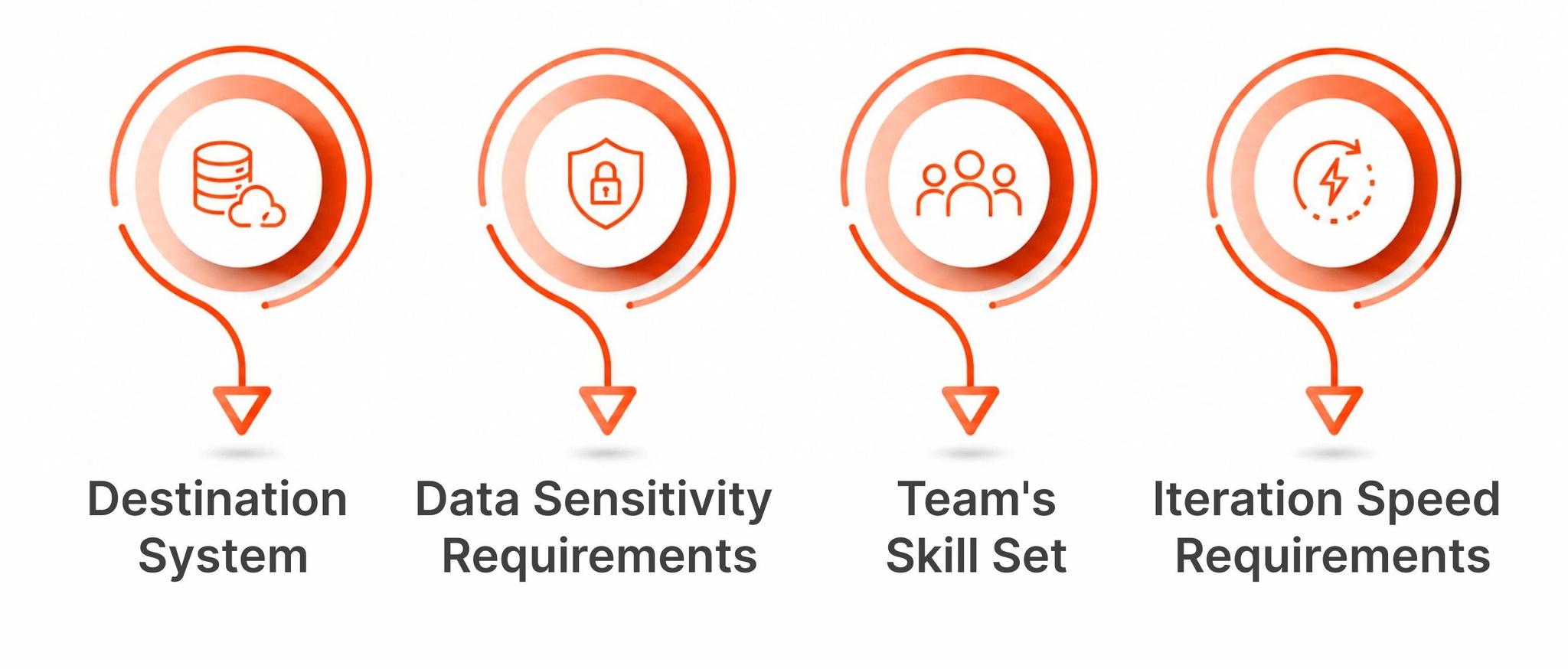
- Your destination system. If your data destination is a modern cloud warehouse like Snowflake, BigQuery, or Databricks, ELT is almost always the right choice. These platforms are built for it. If your destination is a legacy on-premise database, ETL is the safer and more practical option.
- Your data sensitivity requirements. If your business operates in healthcare, finance, or any regulated industry where raw personal data must be masked or filtered before entering any system, ETL gives you that control at the transformation stage before loading begins.
- Your team's skill set. ELT with dbt requires SQL proficiency and familiarity with modern analytics engineering practices. ETL often requires specialised knowledge of tools like Informatica, SSIS, or Talend. Understanding ETL vs ELT when to use also means understanding what your team can actually build and maintain.
- Your iteration speed requirements. If business requirements change frequently and the data team needs to update transformation logic regularly, ELT is significantly faster to iterate on. Changes are made directly in the warehouse without touching a separate transformation environment.
ETL vs ELT Pipeline Considerations for Scale
As data volumes grow, the ETL vs ELT pipeline decision becomes even more consequential.
A. ETL Pipeline at Scale
An ETL pipeline must scale its transformation infrastructure separately from its storage infrastructure. When data volumes double, the transformation layer must also be scaled up, which adds cost and operational complexity.
B. ELT Pipeline at Scale
An ELT pipeline scales with the cloud warehouse. As Snowflake or Databricks scales to handle larger volumes, the transformation workload scales automatically within the same environment. There is no separate infrastructure to manage.
For businesses expecting significant data growth in the next two to three years, ELT pipelines typically deliver lower total cost of ownership and faster performance at scale. The architecture decision made today has a direct impact on infrastructure costs three years from now.
ETL vs ELT Azure: What Microsoft's Ecosystem Offers
For businesses running on Microsoft Azure, the ETL vs ELT Azure conversation has a specific answer.
Azure Data Factory is Microsoft's primary ETL orchestration tool. It supports data movement and transformation across hundreds of connectors and integrates natively with the Azure ecosystem. For organisations with legacy on-premise data sources or regulated data requirements, Azure Data Factory and an ETL approach fits naturally.
Azure Synapse Analytics and Databricks on Azure both support ELT natively. Raw data can be loaded directly into Synapse or a Databricks Delta Lake and transformed using SQL or Python inside the platform. For cloud-native organisations on Azure, this ELT approach delivers faster development cycles and better scalability.
The ETL vs ELT Azure decision ultimately follows the same logic as the broader framework. A cloud-native destination with modern volumes points toward ELT. Legacy or regulated environments with sensitivity requirements points toward ETL or a hybrid combining both.
How Complere Infosystem Helps
Complere Infosystem helps businesses make the right ETL vs ELT decision based on their specific data environment, team capability, and growth trajectory.
The team assesses your current data sources, destination systems, regulatory requirements, and volume projections before recommending an architecture. The recommendation is always driven by business outcomes rather than technology preferences.
Complere has delivered ETL and ELT pipelines across Snowflake, Databricks, Azure Synapse, and BigQuery for clients in healthcare, fintech, e-commerce, and SaaS. Every engagement includes full knowledge transfer so your internal team owns the architecture independently at project end.
Conclusion
The ETL vs ELT decision is one of the most consequential architecture choices a growing business makes. Getting it wrong costs months of engineering time and significant rebuild budget. Getting it right creates a data foundation that scales with the business and supports faster, more reliable decision making at every stage of growth.
In 2026, most cloud-native organisations should be building ELT pipelines. But the right answer depends on your environment, your data sensitivity requirements, and your team. The ETL vs ELT pros and cons are clear. The decision still requires an honest assessment of where your business actually is today.
Ready to make the right data architecture choice for your business? Talk to Complere Infosystem today.