A suspicious health insurance claim rarely proves anything by itself. A $2,000 claim may be completely legitimate. The same claim becomes more interesting when the provider has submitted similar claims unusually often, the member has an unexpected utilization pattern, or the service conflicts with other information available to the insurer.
This is why effective health insurance fraud detection depends on context.
Data warehousing helps create that context by bringing claims, provider, member, eligibility, payment, and other relevant information into an analytical environment where patterns can be examined across records and over time. For Special Investigation Units (SIUs), claims operations teams, and data leaders, the result can be faster prioritization of suspicious activity and better evidence for investigation.
How Does Data Warehousing Help Detect Health Insurance Fraud?
Data warehousing supports health insurance fraud detection by giving fraud analytics and investigation teams access to connected historical information instead of isolated claims. When claims can be analyzed alongside provider profiles, member history, eligibility, payments, and previous activity, insurers can identify unusual patterns, compare behavior with relevant peers, prioritize higher-risk cases, and give investigators more context before they begin detailed review.
CMS uses a similar data-driven approach for public program integrity. Its Data Analytics and Systems Group uses data mining, behavioral analysis, network analysis, predictive methods, and machine learning to identify emerging fraud, waste, and abuse trends.
Fraud Detection Starts With Relationships, Not Just Claims
Traditional claims rules can identify obvious conditions: duplicate claim numbers, unusually high amounts, certain code combinations, or claims submitted outside expected parameters. Those rules remain useful, but many fraud patterns become visible only when relationships are examined.
Consider three different views of the same provider:
| View | What the Analyst Sees |
|---|---|
| Claim-only view | Individual services, codes, dates, and amounts |
| Provider view | Billing frequency, specialties, locations, peer comparisons, and historical behavior |
| Connected view | Provider + claims + members + payments + utilization + related entities |
The third view provides a substantially more investigative context.
CMS's own program integrity environment illustrates this approach. Its One Program Integrity platform uses claims data, provider enrollment data, medical review information, financial data, and investigative data to support fraud, waste, and abuse detection.
For insurers, the principle is similar: fraud analytics becomes stronger when the warehouse preserves relationships between transactions and the people, providers, policies, and payments behind them.
What Data Should Be Connected for Fraud Analytics?
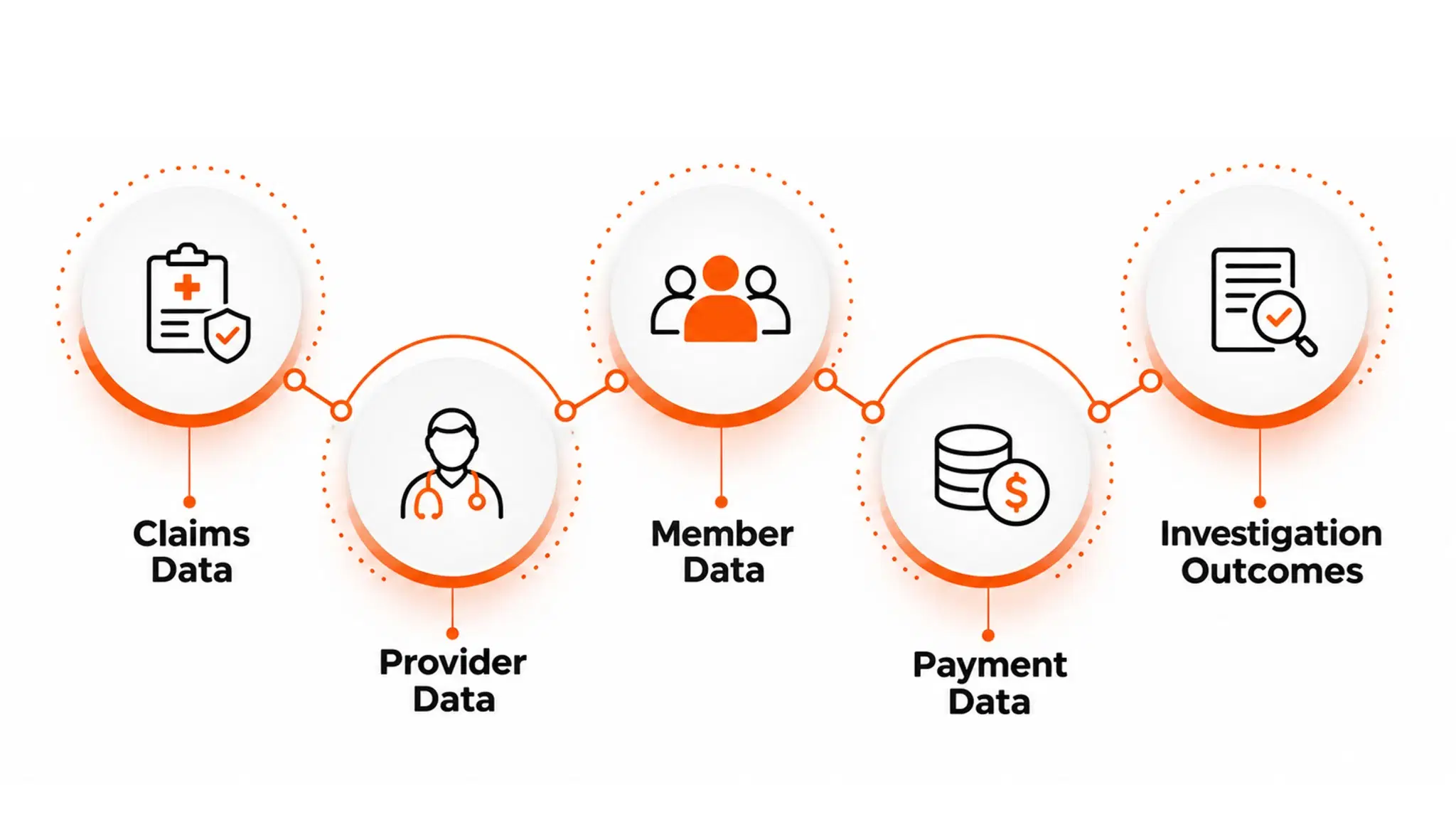
The answer depends on the insurer's business and available data, but fraud-focused healthcare data management commonly requires more than a claims table. A useful analytical foundation may connect:
| Component | What It Includes |
|---|---|
| Claims data | Claim headers, service lines, diagnosis and procedure codes, billed amounts, allowed amounts, payments, adjustments, reversals, and dates |
| Provider data | Provider identifiers, specialty, location, network information, enrollment status, and relevant historical changes |
| Member data | Eligibility, coverage history, plan information, demographics where appropriate and permitted, and historical utilization |
| Payment data | Paid amounts, payment dates, adjustments, recoveries, and other relevant financial information |
| Investigation outcomes | Previously reviewed cases, dispositions, confirmed issues, false positives, and other approved investigation information |
The objective is not to collect every possible field. It is to make the information needed for legitimate fraud detection and investigation available securely and with appropriate access controls.
How Does a Warehouse Turn Raw Claims Into Fraud Signals?
A useful way to understand the role of data warehousing is to follow a claim through the fraud analytics process.
Stage 1: Normalize the Claim
Before comparing claims, insurers need consistent data. Codes, provider identifiers, dates, claim status, monetary fields, and other attributes may arrive differently from different systems.
The warehouse can standardize these elements so analytical rules compare like with like.
Stage 2: Establish the Correct Claim State
Fraud analytics can become misleading if an original claim, adjustment, reversal, and resubmission are incorrectly treated as four independent events.
Claims processing logic should establish how related transactions belong together before behavioral analysis begins.
Stage 3: Add Context
The claim can then be connected to relevant provider, member, eligibility, payment, and historical information. Now the question changes from:
“Is this claim unusual?” to:
“Is this claim unusual for this provider, member, service, peer group, location, or historical pattern?”
Stage 4: Generate Signals
Rules, statistical techniques, machine learning models, or combinations of these approaches can evaluate the enriched dataset.
The result should be a risk signal or case candidate—not an automatic declaration that fraud occurred.
Stage 5: Support Investigation
Higher-priority cases can move to SIU or another appropriate investigation workflow with the relevant supporting data attached.
This last stage matters because good fraud analytics should reduce investigation time, not simply generate more alerts.
What Types of Patterns Can Fraud Analytics Examine?
A unified warehouse can support several analytical approaches. The exact patterns should be designed and validated by qualified fraud, claims, clinical, compliance, and data teams.
1. Provider Behavior
Instead of evaluating a provider against a fixed threshold, analysts can compare activity with relevant peer groups. Questions might include:
- Is billing frequency materially different from similar providers?
- Has utilization changed sharply?
- Are certain services appearing at an unusual rate?
- Are billed or paid amounts behaving differently from historical patterns?
CMS program integrity contractors similarly use claims histories, provider profiles, peer comparisons, average billing reports, and other analytical information to support investigations.
2. Repeated or Related Claims
Claims analysis can examine potential duplicates, repeated services, unusual combinations, reversals, resubmissions, and patterns spread across multiple claims. The warehouse is useful because these relationships may extend across long periods rather than a single processing cycle.
3. Member Utilization
An unusual utilization pattern may deserve additional analysis when viewed in the correct clinical, coverage, and claims context. However, unusual behavior is not itself evidence of wrongdoing. Legitimate medical circumstances can produce unusual patterns, which is why analytical signals require appropriate review.
4. Networks and Relationships
Some schemes may involve relationships across multiple providers, members, organizations, or locations rather than one abnormal transaction. CMS specifically identifies network analysis as one of the advanced techniques it uses to detect emerging fraud trends. This is one area where connected warehouse data can provide capabilities that isolated claims extracts cannot.
Why Does Historical Data Make Fraud Detection Stronger?
Fraud detection is partly a problem of determining what is normal before deciding what is unusual. Suppose Provider A submits 700 claims this month. That number alone tells an analyst very little. If the warehouse shows that the provider historically submits 650–750 claims each month, the volume may be expected. If historical volume has consistently been 100–150 claims, the same 700 claims create a very different analytical signal.
Historical data provides the baseline required for:
- Trend analysis
- Behavioral change detection
- Peer comparison
- Recurring-pattern analysis
- Provider profiling
- Member utilization analysis
CMS's Integrated Data Repository demonstrates the value of retaining integrated information at scale. It combines claims with beneficiary, provider, contract, risk, and other data and supports program integrity and fraud, waste, and abuse analytics.
Can Data Warehousing Help Reduce False Positives?
Potentially, yes—but only if the additional context is used well.
A simple rule might flag every claim above a particular amount. That could create a large queue containing many legitimate claims.
A richer analytical approach could consider the amount alongside procedure, provider specialty, historical behavior, member context, relevant peer activity, and other permitted factors. The additional context can help teams prioritize alerts more intelligently.
This does not mean every sophisticated model automatically produces fewer false positives. Poor data, weak model design, inappropriate thresholds, or biased assumptions can still generate bad results. Fraud detection systems should therefore be monitored against actual investigation outcomes.
Why Should Investigation Outcomes Return to the Data Platform?
This is one of the most important parts of a mature insurance fraud prevention process.
Imagine the analytics system sends 100 cases to the SIU. Investigators determine that 10 require further action, 70 are explainable, and 20 need additional information.
If those outcomes never return to the analytical environment, the fraud team loses valuable feedback.
A better process creates a loop: Detection → Prioritization → Investigation → Outcome → Analytical Improvement
Confirmed findings and false positives can help teams evaluate whether rules, thresholds, models, or data sources are actually useful.
CMS also connects fraud analytics with investigative workflows. Its Fraud Prevention System uses machine learning to monitor Medicare fee-for-service claims and is linked with unified case management capabilities that capture investigative activity.
What Does a Fraud-Ready Data Warehouse Need?
A warehouse built for general reporting is not automatically ready for fraud analytics.
Health insurance operations, SIU, and data leaders should evaluate whether the environment provides:
| Capability | Why It Matters for Fraud Detection |
|---|---|
| Detailed claims history | Reveals recurring and changing behavior |
| Claim lifecycle handling | Prevents adjustments and reversals from creating misleading signals |
| Provider profiling | Supports behavioral and peer analysis |
| Member context | Adds eligibility and utilization information |
| Entity relationships | Helps identify connected activity |
| Investigation history | Creates feedback for improving detection |
| Timely ingestion | Reduces the gap between suspicious activity and analysis |
| Data lineage | Helps investigators understand where evidence originated |
| Controlled access | Protects sensitive claims, member, and investigative data |
This is a different design objective from building a warehouse primarily for executive dashboards.
How Can Faster Data Availability Improve Investigations?
Fraud analytics loses some of its operational value when potentially suspicious activity is identified weeks after payment or after related behavior has continued. Not every fraud use case requires real-time processing. Some investigations benefit more from deep historical analysis than immediate alerts. However, insurers should identify which use cases are time-sensitive and design ingestion accordingly.
For example, pre-payment screening may require much faster data availability than retrospective provider trend analysis. CMS's Fraud Prevention System is specifically used to identify potentially fraudulent claims before provider payments, demonstrating why timing can matter in program integrity operations.
Where Should Human Investigators Remain Involved?
Analytics should help investigators decide where to look, not replace investigation. A statistical anomaly can have a legitimate explanation. A provider may change specialty mix, a member may require unusually intensive care, or billing activity may change because of a valid operational event. For this reason, a strong fraud analytics environment should distinguish between:
- Signal: Something is statistically or logically unusual.
- Case: The signal meets defined criteria for review.
- Finding: Investigation establishes what actually occurred.
That distinction protects teams from treating algorithmic output as evidence of fraud.
The HHS Office of Inspector General similarly describes data mining as identifying potential fraud through screening and analysis, while broader enforcement processes involve investigation and collaboration among multiple organizations.
How Can Health Insurers Strengthen Their Fraud Data Foundation?
Before introducing another fraud model, insurers should examine whether investigators already have the data context they need.
Start with a few recent cases and work backward. Identify which information investigators needed, where they obtained it, how long collection took, and which records had to be manually connected.
If investigators repeatedly switch between claims systems, provider files, spreadsheets, member systems, and separate analytical tools, the first opportunity may be data integration rather than a new algorithm.
A data engineering partner such as Complere Infosystem can support this foundation by helping insurers integrate claims and related datasets, develop analytics-ready models, establish data quality controls, and build governed environments on platforms such as Databricks, Snowflake, Azure, or AWS. The objective should be to give fraud analytics and SIU teams reliable connected data rather than positioning the warehouse itself as a fraud-detection product.
Once the foundation is reliable, fraud rules, statistical methods, machine learning, and investigation tools can work with better context.
Key Takeaway
Effective health insurance fraud detection is not simply about finding unusual claims. It is about understanding whether activity is unusual when compared with the right provider, member, historical, payment, and relationship context. Data warehousing provides the foundation for that analysis by connecting information that would otherwise remain fragmented. For SIU and operations teams, the strongest architecture goes one step further: it connects fraud analytics with investigation outcomes so detection can improve over time.
The goal is not to automate accusations. It is to help investigators identify meaningful signals sooner, analyze claims with better context, and focus their effort where deeper review is justified.
Give fraud and SIU teams connected, investigation-ready data that helps them find meaningful patterns without searching across disconnected systems.