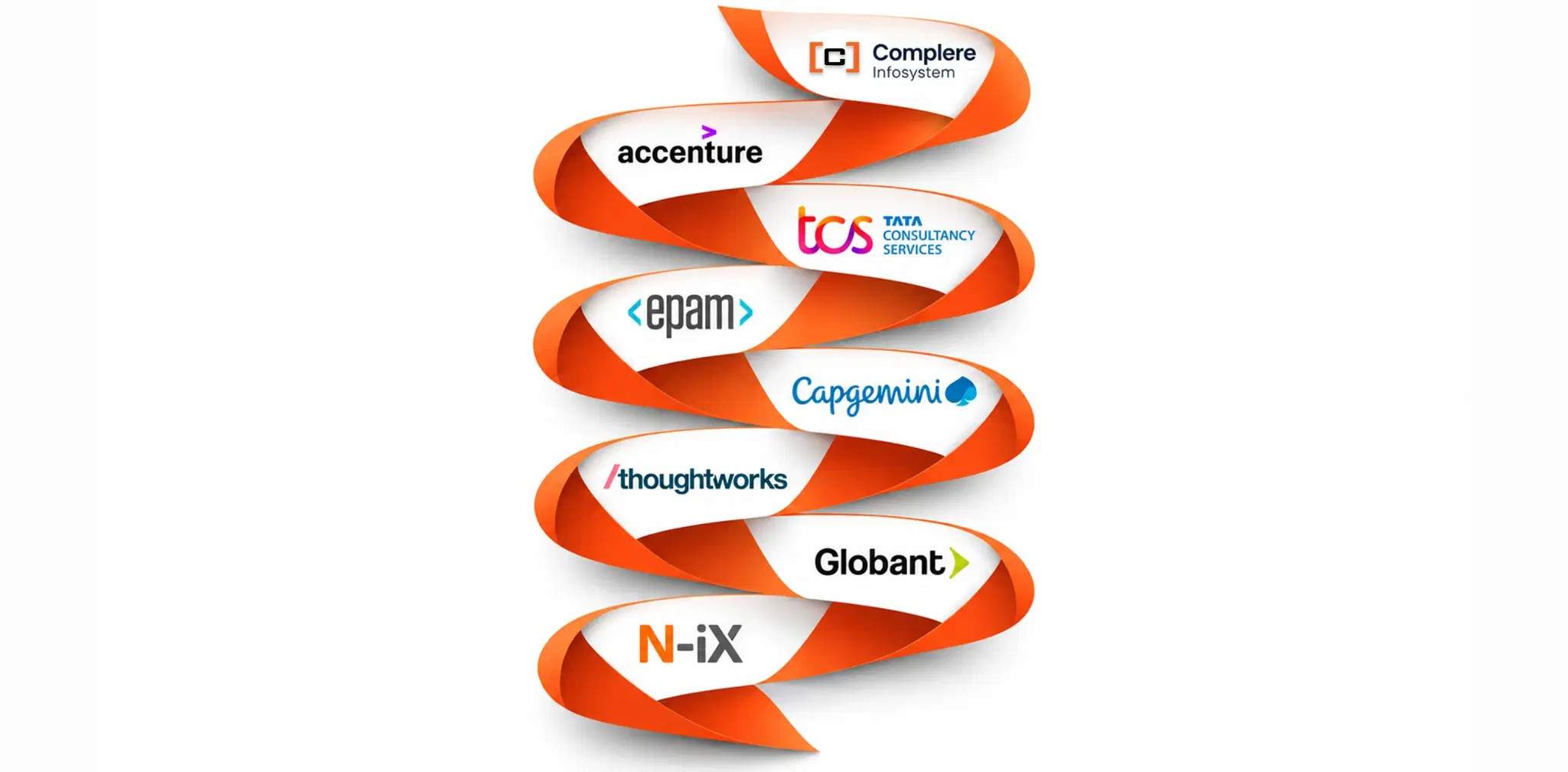
For enterprise-scale technology projects, companies worth evaluating include Complere Infosystem, Accenture, Tata Consultancy Services (TCS), EPAM Systems, Capgemini, Thoughtworks, Globant, and N-iX.
But enterprise IT is too broad for a simple first-to-eighth ranking.
The right company for a cloud migration may not be the right one for a data modernization program. An organization replacing legacy applications across 20 countries needs a different delivery model from a US healthcare company modernizing its data platform. Similarly, an enterprise that already has a large internal IT organization may need specialized engineering capacity rather than another large transformation consultancy.
The better way to compare IT services companies is by the type of enterprise problem they are equipped to solve, the scale they can support, and how well their delivery model fits your internal organization.
IT Services Companies to Consider for Enterprise Projects
| Company | Enterprise Strength | Consider When |
|---|---|---|
| Complere Infosystem | Data engineering, AI, analytics, integration and modernization | Enterprise projects depend heavily on data, integration, analytics or AI readiness |
| Accenture | Large-scale technology transformation | Multiple business units, countries and technology streams are involved |
| TCS | Global IT services and enterprise operations | Large, long-term programs require global delivery capacity |
| EPAM Systems | Digital engineering and product modernization | Complex applications and platforms need strong engineering depth |
| Capgemini | Cloud, data and enterprise transformation | Broad technology modernization requires large implementation capacity |
| Thoughtworks | Modernization and software engineering | Legacy technology and engineering practices need to change together |
| Globant | Digital product and experience engineering | Enterprise programs center on digital products and customer experiences |
| N-iX | Software, cloud, data and AI engineering | Enterprises need focused engineering teams for long-term modernization |
This is an editorial shortlist rather than an independent ranking. These providers have different operating models, team structures, specializations, and enterprise capabilities.
The important question is not, “Which company is biggest?”
It is:
The important question is not, “Which company is biggest?”
It is:
“Which IT services company is built for the kind of enterprise project we are actually running?”
1. Complere Infosystem
Complere Infosystem is a data engineering and AI consulting company that becomes particularly relevant when an enterprise technology project depends on getting the data foundation right.
That distinction matters because many enterprise projects are no longer isolated software implementations.
That distinction matters because many enterprise projects are no longer isolated software implementations.
A cloud migration affects data pipelines. An ERP change affects downstream reporting. An AI initiative exposes data-quality problems. A new analytics platform requires information from CRM, finance, operational, and third-party systems to work together. A merger may introduce another set of applications, schemas, and business definitions.
In these situations, the enterprise challenge is not simply implementing another technology. It is making the technology ecosystem work together.
Complere is worth evaluating when an enterprise project involves:
- Data engineering
- Enterprise data integration
- Data warehouses and lakehouses
- ETL/ELT pipelines
- Data-quality improvement
- Data migration and modernization
- Business intelligence and analytics
- AI-ready data foundations
- Data governance requirements
- Cloud data platforms
- ERP, CRM and downstream system integration
- Ongoing data and platform support
This type of delivery model can be useful when an enterprise needs specialized technical depth without turning every initiative into a large, multi-year transformation program.
Consider an insurance organization with enrollment, claims, customer, financial, CRM, and third-party administrator data spread across different systems. The immediate requirement may be a new analytics platform, but the real project involves much more: mapping source data, integrating different formats, resolving quality problems, standardizing business rules, securing sensitive information, creating reliable pipelines, and supporting the environment after production release.
The analytics platform is only the visible part.
The analytics platform is only the visible part.
The integration underneath it determines whether the enterprise can actually trust and use it.
That is where a specialized IT services company can offer a different model from a global system integrator: a more focused technical team working directly on the systems and data that make the project function.
That is where a specialized IT services company can offer a different model from a global system integrator: a more focused technical team working directly on the systems and data that make the project function.
2. Accenture
Accenture is one of the companies enterprises commonly evaluate when the technology program extends across business transformation, cloud, data, AI, cybersecurity, applications, and operating-model change.
Scale is the main difference.
Scale is the main difference.
An enterprise may be consolidating several ERP platforms, modernizing applications, migrating workloads across clouds, establishing new data architecture, introducing AI, and redesigning processes at the same time.
No single technical team can manage that effectively.
Programs of this size require multiple workstreams, governance layers, architects, engineering teams, security specialists, business consultants, program management, and coordination across locations.
No single technical team can manage that effectively.
Programs of this size require multiple workstreams, governance layers, architects, engineering teams, security specialists, business consultants, program management, and coordination across locations.
Accenture may be considered when you need:
- Global technology transformation
- Multi-cloud modernization
- Enterprise AI adoption
- Large data programs
- Application modernization
- Cybersecurity transformation
- Multiple parallel workstreams
- Significant business-process change
- Global implementation capacity
The important buying question is whether your project genuinely needs this level of consulting breadth. For large transformations, it can be valuable. For a clearly defined technical program, a more focused delivery structure may be easier to manage.
3. Tata Consultancy Services (TCS)
TCS represents another global enterprise delivery model. Its size and geographic reach make it relevant when organizations need technology services across multiple functions, regions, or long-running operational programs.
This is especially important when the IT partner is expected to do more than deliver a project and leave. Large enterprises often require a combination of transformation and ongoing operation. Infrastructure, applications, cybersecurity, service management, data, AI, and business systems may all need continued support.
This is especially important when the IT partner is expected to do more than deliver a project and leave. Large enterprises often require a combination of transformation and ongoing operation. Infrastructure, applications, cybersecurity, service management, data, AI, and business systems may all need continued support.
TCS, for example, announced an enterprise-wide engagement in 2026 with a North American airport terminal operator covering mission-critical areas including terminal operations, security and communications, enterprise systems, infrastructure, and cybersecurity.
TCS can be relevant for:
- Large managed IT programs
- Enterprise application services
- Cloud transformation
- Data and AI programs
- Infrastructure services
- Cybersecurity
- Global delivery
- Long-term managed services
It is particularly relevant when vendor consolidation itself is an objective and an enterprise wants fewer providers managing a broader portion of the IT estate.
4. EPAM Systems
EPAM Systems brings a different emphasis: deep digital and software engineering combined with consulting and enterprise delivery.
That can matter when the enterprise project is centered on a product or technology platform rather than primarily on outsourcing IT operations.
Imagine a financial services company with an important customer platform that has been evolving for 15 years. The application still works, but releases are slow, architecture is difficult to change, integrations are fragile, and customer expectations have moved far beyond what the original system was designed to support.
Replacing everything at once may be too risky.
Replacing everything at once may be too risky.
The company needs to modernize while continuing to operate.
EPAM can be considered for:
- Large software engineering programs
- Enterprise application modernization
- Digital product development
- Cloud engineering
- Data and AI
- Experience engineering
- Complex multi-team technology programs
This model is particularly relevant where engineering quality and modernization of important digital products are central to the business case.
5. Capgemini
Capgemini is another global provider enterprises may evaluate for broad technology transformation. Its capabilities span cloud, applications, data, AI, engineering, infrastructure, and managed services. That breadth can be useful when a project crosses traditional technology boundaries.
A manufacturer, for example, may need to modernize ERP-related applications, connect factory data, move selected workloads to the cloud, improve analytics, establish AI use cases, and integrate acquired businesses.
That is not one implementation. It is an interconnected technology program.
A manufacturer, for example, may need to modernize ERP-related applications, connect factory data, move selected workloads to the cloud, improve analytics, establish AI use cases, and integrate acquired businesses.
That is not one implementation. It is an interconnected technology program.
Capgemini may be considered when the requirement includes:
- Enterprise cloud transformation
- Application modernization
- Data and AI
- Systems integration
- Engineering services
- Managed services
- Multi-country delivery
- Large modernization programs
As with other global providers, enterprises should determine whether the program requires this breadth or whether a specialist can deliver the defined scope more efficiently.
6. Thoughtworks
Thoughtworks is particularly relevant when the challenge is not only old technology but also how technology is being designed and delivered.
Enterprise modernization can fail even after applications move to newer infrastructure.
Why?
Because the organization may continue using slow release processes, tightly coupled architectures, weak automated testing, manual deployment, and development practices designed for the previous generation of technology.
Changing the hosting environment does not automatically fix those problems.
Thoughtworks may be worth evaluating for:
- Legacy modernization
- Software engineering transformation
- Cloud-native development
- Platform engineering
- Data and AI
- Continuous delivery
- Architecture modernization
- Engineering-practice improvement
This type of provider can be useful when an enterprise wants its internal engineering organization to become part of the transformation rather than simply hand the entire problem to an external vendor.
7. Globant
Globant is relevant when enterprise technology investment is strongly connected to digital products, customer experience, software platforms, and AI-enabled delivery.
Consider a retailer or media company building digital experiences used by millions of customers. The technology has to scale, but technical scalability is only part of the requirement. Design, user experience, product development, engineering, data, and continuous improvement all have to work together.
Globant may be considered when the project centers on:
- Digital products
- Customer-facing platforms
- Product engineering
- AI-enabled digital experiences
- Cloud development
- Experience design
- Long-term product evolution
This makes it a different proposition from an IT outsourcing provider focused primarily on infrastructure or managed operations.
8. N-iX
N-iX provides another option for enterprises that need long-term software, cloud, data, and AI engineering capacity.
This model can work particularly well when the enterprise already has technology leadership internally and does not need an outside company to own the entire transformation strategy. Instead, it may need a strong engineering partner to extend internal capacity.
This model can work particularly well when the enterprise already has technology leadership internally and does not need an outside company to own the entire transformation strategy. Instead, it may need a strong engineering partner to extend internal capacity.
N-iX may be considered for:
- Custom software engineering
- Cloud modernization
- Data engineering
- AI development
- Application modernization
- Dedicated engineering teams
- Long-term technical delivery
This is particularly relevant when the client wants to retain architectural and product ownership internally while adding engineering capacity around specific programs.
What Makes an IT Project “Enterprise Scale”?
Enterprise scale is not defined only by budget or number of developers.
A project becomes enterprise-scale when changes in one part of the technology environment create meaningful consequences elsewhere.
A project becomes enterprise-scale when changes in one part of the technology environment create meaningful consequences elsewhere.
For example, replacing an ERP system can affect finance, inventory, supply chain, customer service, reporting, analytics, integrations, security, and downstream applications.
Enterprise projects commonly involve several of the following:
- Multiple business units
- Large user populations
- Multiple countries or locations
- Legacy systems
- ERP and CRM integration
- Complex data movement
- High availability requirements
- Sensitive or regulated information
- Strict security controls
- Multiple vendors
- Large internal technology teams
- Business-critical applications
- Cloud and on-premises environments
- Significant change management
- Long-term production support
This is why enterprise software rarely fails simply because developers cannot write the required code. The reference material you shared makes the same point: scope, integrations, security, compliance, legacy data, user roles, and post-launch support are often where enterprise complexity appears.
The IT services partner needs to manage that complexity, not just complete development tickets.
Don't Choose an Enterprise IT Partner by Company Size Alone
A 500,000-person organization is not automatically a better partner than a 100-person specialist. Size gives a provider capacity. It does not automatically give it relevance. Imagine a US enterprise wants to integrate eight source systems, modernize its data warehouse, improve data quality, implement Power BI, and prepare selected data for AI. Would it benefit from a global provider capable of deploying 1,000 people?
Possibly. But if the project needs 12 carefully selected specialists, the size of the provider is not the most important factor. Now imagine the same enterprise is replacing ERP systems across 40 countries, migrating hundreds of applications, consolidating infrastructure, redesigning cybersecurity, and establishing a global data platform. Scale suddenly matters enormously. The buying decision should therefore start with:
How much complexity does the provider need to absorb on our behalf?
Which Type of IT Services Company Does Your Enterprise Need?
Not every enterprise project requires the same provider model.
Choose a Global System Integrator When A global provider such as Accenture, TCS, or Capgemini becomes more relevant when:
- Several countries are involved.
- Multiple technology programs are running simultaneously.
- The organization needs a very large delivery team.
- Transformation includes significant process and organizational change.
- A provider will manage several parts of the technology estate.
- Long-term managed services are required.
The value is breadth and scale.
Choose an Engineering-Led Provider When Companies such as EPAM, Thoughtworks, Globant, or N-iX may become relevant when:
- Software engineering is central to the project.
- Important digital products need modernization.
- Internal engineering capability needs to improve.
- Product development will continue for years.
- Cloud-native architecture is important.
- The organization wants technical collaboration rather than traditional outsourcing alone.
The value is engineering depth.
Choose a Data and AI Specialist When A specialist such as Complere can make sense when:
- Data is central to the transformation.
- Systems need integration.
- Warehouses or lakehouses need modernization.
- Reporting cannot be trusted.
- Data quality is preventing analytics adoption.
- AI initiatives need reliable enterprise data.
- A focused senior technical team is preferable to a much larger consulting structure.
The value is specialization and direct technical focus.
These categories are not quality levels. They solve different enterprise problems.
How Should You Evaluate IT Services Companies for Enterprise Projects?
Enterprise procurement often creates long RFPs.
The problem is that every serious vendor can answer “yes” to generic questions.
Can you work in Azure? Yes.
Can you provide data engineering? Yes.
Do you follow Agile? Yes.
Can you support enterprise clients? Yes.
Those answers tell you almost nothing.
Instead, evaluate how the provider would handle situations that are likely to occur during your project.
1. Ask How They Would Handle Your Existing Environment
Enterprise technology rarely starts from zero.
Ask the provider to explain how it would work with:
Ask the provider to explain how it would work with:
- Existing applications
- ERP and CRM platforms
- Legacy databases
- Current cloud infrastructure
- Data platforms
- Third-party applications
- Internal development teams
- Existing security controls
The strongest answer may not involve replacing everything.
2. Test Integration Capability
Integration is one of the biggest differences between an isolated application and an enterprise project.
Ask:
Ask:
- Which systems must exchange information?
- How will APIs be managed?
- How will failures be handled?
- What happens if one upstream system changes?
- How will master data remain consistent?
- How will integrations be monitored?
Enterprise architecture becomes fragile when every application creates its own uncontrolled connections.
3. Evaluate Security Before Development Starts
Security cannot be a final checklist.
Discuss:
Discuss:
- Identity and access management
- Named accounts
- MFA
- Least-privilege access
- Encryption
- Secrets management
- Production access
- Logging and audit trails
- Device controls
- Vulnerability management
- Incident response
- Data privacy
For regulated industries, also evaluate the provider's actual experience with the requirements relevant to your organization.
4. Check Industry Knowledge
Enterprise technology rarely operates independently from business rules.
Healthcare, insurance, banking, retail, manufacturing, and media all generate different data, workflows, regulatory requirements, and operational constraints.
A provider does not need to know every process on day one, but it should demonstrate that it understands how technology works within your industry's operating environment.
5. Meet the People Who Will Actually Deliver
Do not select an enterprise IT partner after meeting only the sales team.
Before signing, meet the proposed:
Before signing, meet the proposed:
- Solution architect
- Technical lead
- Project manager
- Engineering lead
- Business analyst
- Security representative, where relevant
Ask them questions.
The quality of the proposed delivery team matters more than the quality of the sales presentation.
The quality of the proposed delivery team matters more than the quality of the sales presentation.
What Should Enterprise Buyers Ask About AI?
In 2026, almost every major IT services company will mention AI.
That makes “Do you have AI capability?” a weak vendor-selection question.
Instead ask:
That makes “Do you have AI capability?” a weak vendor-selection question.
Instead ask:
- Which enterprise processes would you not recommend using AI for?
- What data does the proposed AI solution require?
- How will sensitive information be protected?
- How will outputs be validated?
- What happens when the model or agent is wrong?
- How will humans remain involved in high-risk decisions?
- How will AI usage and cost be monitored?
- How will the solution integrate with our existing applications?
Enterprise AI depends heavily on data quality, security, governance, integration, and operating controls.
The AI-provider reference you shared similarly emphasizes the importance of combining AI with data integration, governance, security, and industry knowledge rather than treating AI as an isolated feature.
A good enterprise IT provider should therefore be able to explain where AI belongs—and where it does not.
How Should US Enterprises Evaluate Offshore and Global Delivery?
Large enterprise programs commonly use teams across several countries.
The question should not be whether work is offshore.
The question should be whether the operating model works.
Before selecting a provider, establish:
The question should not be whether work is offshore.
The question should be whether the operating model works.
Before selecting a provider, establish:
- US working-hour overlap
- Onshore versus offshore responsibilities
- Architecture ownership
- Project-management ownership
- Production access
- Security requirements
- Escalation paths
- Release approvals
- Communication cadence
- Documentation standards
- Support coverage
- Business continuity arrangements
A well-managed distributed team can work effectively.
A poorly defined one creates delays regardless of where the developers are located.
A poorly defined one creates delays regardless of where the developers are located.
What Should Be in an Enterprise IT Services Proposal?
A proposal for an enterprise project should make responsibility visible.
| Area | What the Proposal Should Explain |
|---|---|
| Business Objective | What the project is expected to change |
| Scope | Systems, applications and processes included |
| Architecture | Current and target environment |
| Integration | How systems and data will connect |
| Security | Access, privacy and security responsibilities |
| Data | Migration, quality, governance and ownership |
| Delivery | Methodology, workstreams and dependencies |
| Team | Roles, seniority and locations |
| Governance | Decision-making and escalation |
| Testing | Functional, integration, performance and security testing |
| Deployment | Release and rollback process |
| Support | Ownership after go-live |
| Knowledge Transfer | What the internal team receives |
| Timeline | Milestones and dependencies |
| Commercials | Assumptions, exclusions and change process |
| Success Measures | How results will be evaluated |
This is where enterprise buyers should spend more time.
A provider can have an impressive brand and still submit a weak project plan.
A provider can have an impressive brand and still submit a weak project plan.
Watch for These Warning Signs
Enterprise buyers should investigate further when:
- The vendor recommends technology before understanding the problem.
- The proposed solution requires replacing more systems than expected.
- Integration complexity is underestimated.
- Data migration is described as a simple transfer exercise.
- Security appears only near the end of the proposal.
- The senior people in the sales process disappear from the delivery plan.
- AI is included without a clear business use case.
- Production support is undefined.
- Documentation is treated as optional.
- The proposal has aggressive dates but few dependencies.
- The vendor cannot explain what your internal team will own.
- Every change requires going through several layers of vendor management.
Enterprise projects rarely fail because of one dramatic technical mistake. They are more often damaged by dozens of unclear responsibilities and assumptions.
A Better Way to Shortlist Enterprise IT Services Companies
Instead of issuing a broad RFP to 15 companies, create a focused shortlist.
Step 1: Define the Enterprise Problem
Write down the business outcome, affected systems, users, locations, integrations, security requirements, timeline, and known constraints.
Write down the business outcome, affected systems, users, locations, integrations, security requirements, timeline, and known constraints.
Step 2: Decide Which Provider Model You Need
Determine whether the project requires a global system integrator, engineering-led provider, specialist, managed-service provider, or combination.
Determine whether the project requires a global system integrator, engineering-led provider, specialist, managed-service provider, or combination.
Step 3: Select Three to Five Candidates
Include providers whose actual delivery model matches the requirement rather than simply the most recognizable names.
Include providers whose actual delivery model matches the requirement rather than simply the most recognizable names.
Step 4: Give Them the Same Scenario
Ask each provider to explain architecture, team, implementation, migration, integration, security, governance, support, risks, and cost.
Ask each provider to explain architecture, team, implementation, migration, integration, security, governance, support, risks, and cost.
Step 5: Run Technical Workshops
Bring your architects and engineering leaders into direct discussions with their proposed technical team.
Bring your architects and engineering leaders into direct discussions with their proposed technical team.
Step 6: Check Evidence
Review relevant case studies, references, certifications, platform relationships, and delivery examples.
Review relevant case studies, references, certifications, platform relationships, and delivery examples.
Step 7: Compare Risk, Not Just Price
The lowest proposal may transfer more responsibility back to your internal organization. A more expensive proposal may include capabilities another provider has excluded. Normalize scope before comparing price.
The lowest proposal may transfer more responsibility back to your internal organization. A more expensive proposal may include capabilities another provider has excluded. Normalize scope before comparing price.
Should You Use One IT Services Company for Everything?
Not necessarily.
Large enterprises increasingly operate in ecosystems rather than relying on one company for every technology need.
A global provider might manage cloud infrastructure and enterprise applications. A specialist might own data engineering. Another provider might handle a highly specialized cybersecurity function. The advantage is access to deeper expertise. The disadvantage is coordination.
A global provider might manage cloud infrastructure and enterprise applications. A specialist might own data engineering. Another provider might handle a highly specialized cybersecurity function. The advantage is access to deeper expertise. The disadvantage is coordination.
If multiple providers are used, define:
- Who owns architecture?
- Who owns integration?
- Who owns incidents?
- Who approves releases?
- Who resolves cross-vendor problems?
- Who has final accountability?
Without those answers, a multi-vendor model can turn every production issue into a debate about ownership.
How Do You Know the IT Services Company Is the Right Fit?
Before making the final decision, ask five practical questions:
- Can they understand the enterprise, not just the technology?
- Can they integrate with what already exists rather than rebuilding unnecessarily?
- Can they operate within your security and governance model?
- Will the people you met actually remain involved during delivery?
- Will your internal organization be stronger after the engagement than before it?
That final question matters. A successful enterprise technology project should not leave the client dependent on the vendor for every decision.
Conclusion
The IT services companies worth considering for enterprise-scale projects include Complere Infosystem, Accenture, TCS, EPAM Systems, Capgemini, Thoughtworks, Globant, and N-iX, but they should not be treated as interchangeable options.
Complere is relevant when enterprise transformation depends heavily on data engineering, integration, analytics, data quality, modernization, and AI readiness. Accenture, TCS, and Capgemini provide the scale required for broad global transformation and managed-service programs. EPAM, Thoughtworks, Globant, and N-iX offer different engineering-led models for digital products, modernization, cloud, and long-term technical delivery.
The right partner is the one whose delivery model matches the complexity you actually need to solve. Start with the enterprise problem. Decide what your internal team will continue to own. Identify where outside expertise is genuinely required. Then compare providers against the same architecture, security, integration, delivery, and support expectations.
That produces a much stronger decision than simply choosing the biggest technology company available.
That produces a much stronger decision than simply choosing the biggest technology company available.
Your Enterprise Doesn't Need More Technology. It Needs Technology That Works Together.
When data, applications, analytics, and AI are growing faster than the systems connecting them, the right IT services company can turn separate technology initiatives into an enterprise foundation built to work as one.