Your data pipeline broke at 2 AM. Your analytics team arrived to stale dashboards. Your leadership team made a critical decision on yesterday's numbers. And somewhere in the middle of it all, your engineering team spent four hours debugging a process that should have been automated.
This is the reality of legacy ETL in 2026. And it is costing businesses more than downtime. It is costing them competitive advantage.
Modern ETL architecture is not just a technical upgrade. It is a strategic business decision that determines how fast your organisation can move, how confidently your leaders can decide, and how effectively your data teams can scale without adding headcount. According to Gartner, organisations that modernise their data infrastructure report 40% faster time-to-insight and 35% reduction in data engineering overhead within the first year.
This guide breaks down what modern ETL architecture actually means in 2026, why it matters for business outcomes, and how data teams can approach the transition strategically.
What Is Modern ETL Architecture?
Traditional ETL — Extract, Transform, Load — was designed for a simpler data world. Batch jobs ran overnight. Data moved slowly from source to warehouse. Transformations happened in rigid, monolithic pipelines that broke whenever a source system changed.
Modern ETL architecture is fundamentally different. It is cloud-native, event-driven, and built for the scale and speed that 2026 business operations require. Rather than moving data in scheduled batches, modern ETL pipelines process data continuously, handle schema changes gracefully, and deliver clean, governed data to consumers in near real-time.
The shift from traditional to modern ETL is not about replacing one tool with another. It is about rethinking the entire philosophy of how data moves through an organisation.
Why Legacy ETL Is Failing Business Teams in 2026
The business case for ETL modernization starts with understanding what legacy architecture is actually costing your organisation right now.
1. Slow Time-to-Insight
Legacy batch pipelines mean your analytics team is always working with yesterday's data. In competitive markets where pricing, inventory, and customer behaviour shift hourly, that lag is not acceptable.
2. High Maintenance Overhead
Traditional ETL pipelines are brittle. Every source system change, every schema update, every new data volume spike requires manual intervention. Data engineers spend more time firefighting than building.
3. Inability to Scale
On-premises ETL infrastructure scales vertically — meaning more hardware, more cost, more complexity. Modern ETL pipeline architecture scales horizontally and elastically in the cloud, handling ten times the volume at a fraction of the cost.
4. Limited AI Readiness
Every AI and machine learning initiative your business wants to pursue depends on clean, reliable, governed data. Legacy ETL cannot provide the foundation that agentic AI for ETL modernization requires. Your AI ambitions are only as strong as your data infrastructure beneath them.
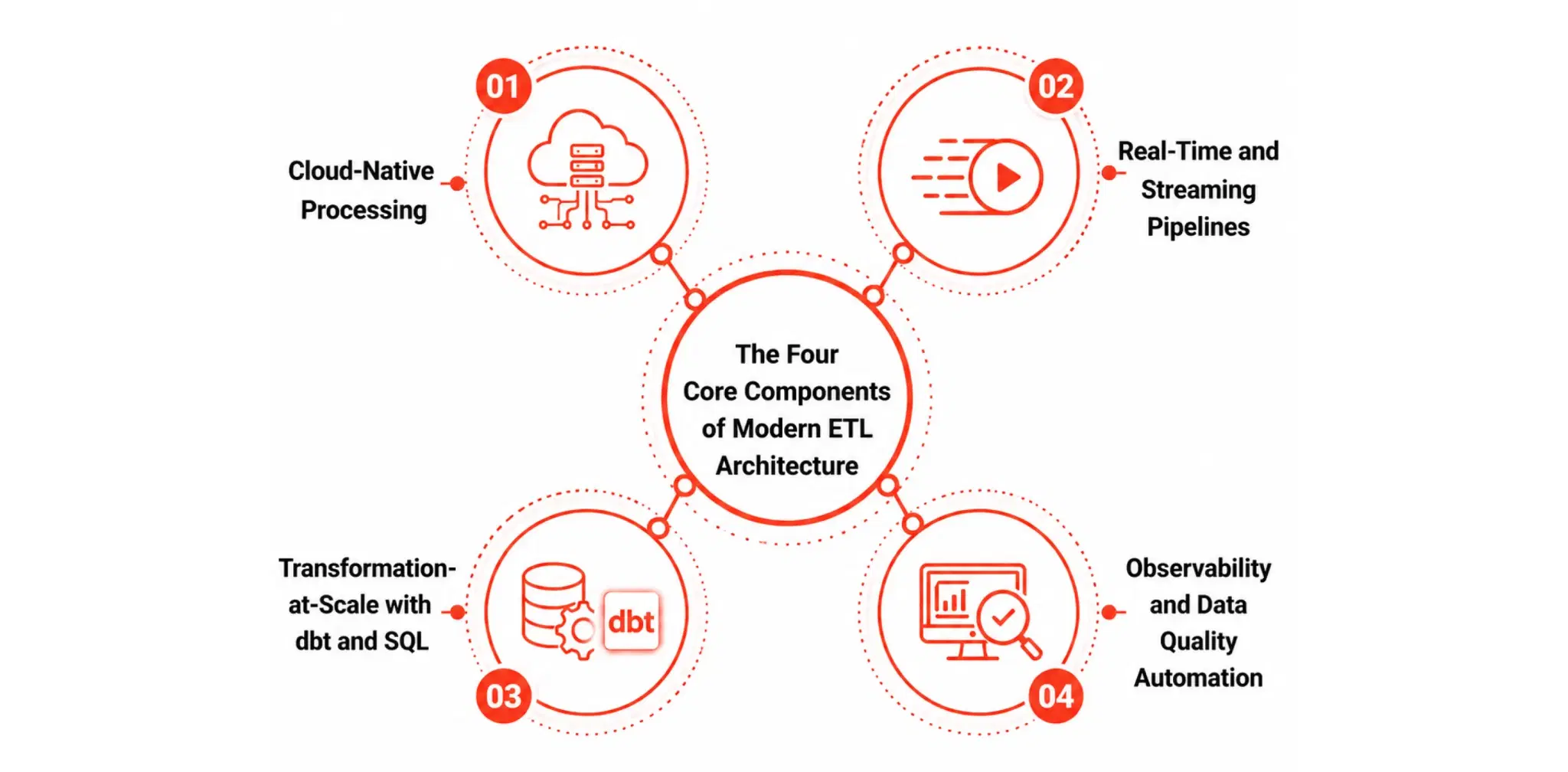
The Four Core Components of Modern ETL Architecture
Understanding modern ETL architecture requires understanding its four foundational components and how they work together to deliver the outcomes businesses actually need.
1. Cloud-Native Processing
ETL modernization to cloud platforms is the most foundational shift in modern data architecture. Cloud platforms like Snowflake, Databricks, and AWS Glue provide elastic compute that scales automatically with data volume, pay-per-use economics that align cost with actual usage, and built-in redundancy that eliminates single points of failure.
ETL modernization to cloud platform removes the infrastructure management burden from data teams entirely. Engineers focus on data logic rather than server maintenance. And the organisation gets a data platform that can scale from gigabytes to petabytes without an architecture redesign.
2. Real-Time and Streaming Pipelines
Modern ETL pipelines are not batch-first. They are streaming-first with batch as a fallback for appropriate use cases. Apache Kafka, Databricks Structured Streaming, and AWS Kinesis enable data teams to build modern ETL pipelines that ingest, transform, and deliver data in seconds rather than hours.
For businesses in financial services, healthcare operations, and e-commerce, real-time data is not a nice-to-have. It is the difference between catching fraud before it happens and discovering it after the loss is recorded.
3. Transformation-at-Scale with dbt and SQL
The modern ETL tool landscape has shifted significantly toward analytics engineering frameworks like dbt. Rather than writing complex custom transformation code in proprietary tools, data teams now define transformations as modular, testable SQL models that are version-controlled, documented, and reusable.
dbt combined with a cloud data warehouse creates a modern ETL architecture where transformations are transparent, auditable, and maintainable by any data engineer on the team — not just the one who originally built the pipeline.
4. Observability and Data Quality Automation
Modern ETL architecture treats data quality and pipeline observability as first-class engineering concerns rather than afterthoughts. Tools like Monte Carlo, Great Expectations, and Databricks Delta Live Tables build automated quality checks directly into the pipeline — catching anomalies, schema drift, and volume changes before they reach downstream consumers.
This is where modern ETL tool selection makes the most measurable difference to business outcomes. A pipeline that silently passes bad data is more dangerous than a pipeline that fails loudly.
Agentic AI for ETL Modernization: The Next Frontier
The most significant development in modern ETL architecture in 2026 is the emergence of agentic AI for ETL modernization. AI agents are now capable of monitoring pipeline health, diagnosing failures, suggesting optimizations, and in some cases self-healing pipelines without human intervention.
Agentic AI for ETL modernization does not replace data engineers. It elevates them. Engineers who previously spent 60% of their time on pipeline maintenance can now focus on high-value architecture decisions, new use case development, and data product creation. The routine becomes automated. The strategic becomes human.
For business leaders, agentic AI in the modern ETL pipeline means faster incident resolution, lower engineering overhead, and a data infrastructure that improves continuously rather than degrading over time.
How to Approach ETL Modernization Without Disrupting Operations
The biggest barrier to ETL modernization is not technology. It is the fear of disruption. Data teams worry about breaking existing pipelines. Business teams worry about losing access to reports during migration. Leadership worries about cost overruns on projects that historically underdeliver.
A proven approach to ETL modernization without disruption follows three phases.
Phase 1: Identify and Prioritise
Not every pipeline needs to be modernised at the same time. Audit your existing ETL landscape and identify the pipelines with the highest business impact, the highest maintenance burden, and the lowest migration complexity. Start there.
Phase 2: Build in Parallel
Modern ETL pipelines should be built alongside existing ones rather than replacing them immediately. This allows validation, testing, and stakeholder confidence-building before the cutover. Zero business disruption is achievable when migration is planned as a parallel-build process.
Phase 3: Expand Incrementally
Once the first modern ETL pipeline is proven in production, expand the pattern systematically across the data landscape. Each successful migration builds organisational confidence and engineering capability simultaneously.
Choosing the Right Modern ETL Tool for Your Data Team
The modern ETL tool landscape in 2026 offers more choice than ever. The right tool depends on your specific use case, team capability, and cloud environment.
- Databricks with Delta Live Tables — The most comprehensive modern ETL pipeline platform for cloud-native batch and streaming workloads.
- dbt with Snowflake — The most accessible and maintainable architecture for SQL-first transformation teams.
- AWS Glue with Apache Iceberg — Strong governance and cost efficiency for organisations in the AWS ecosystem.
The most important selection criterion is not features. It is fit. The best modern ETL tool is the one your team can fully own, maintain, and evolve independently after implementation.
The Business Outcome That Justifies Every Investment
Modern ETL architecture is not an IT project. It is a business capability investment. The organisations that have completed ETL modernization consistently report the same outcomes: faster decisions, lower engineering costs, higher data quality, and the data foundation that makes every AI initiative possible.
The organisations still running legacy ETL are not just paying a technical debt. They are paying it with slower decisions, more manual work, and an AI strategy that cannot fully launch because the data beneath it is not reliable enough to trust.
In 2026, modern ETL architecture is the foundation everything else is built on. Get it right and every subsequent data investment compounds. Get it wrong and every subsequent initiative fights against it.
Conclusion
Legacy ETL is not just a technical liability — it is a business one. Stale dashboards, brittle pipelines, and manual firefighting are direct costs that compound as your data needs grow. Modern ETL architecture solves this with cloud-native scalability, real-time streaming, transformation frameworks like dbt, and observability built into every layer of the pipeline.
The transition does not have to be disruptive. A phased, parallel-build approach lets organisations modernise incrementally without risking existing operations. And with agentic AI now capable of self-healing pipelines and automating routine maintenance, the case for modernization has never been stronger.
In 2026, the data foundation you build today determines the speed of every business decision, the accuracy of every AI initiative, and the capacity of your engineering team to focus on work that actually moves the business forward.
Ready to modernise your ETL architecture and build the data foundation your business actually needs? Connect with Complere Infosystem's data engineering experts today.