A retail company doubled its customer base in eighteen months. Orders were flowing. Revenue was growing. But behind the scenes their data team was drowning.
Reports were delayed. Dashboards showed conflicting numbers. The analytics team spent more time fixing broken data flows than generating insights. The business was growing. The data infrastructure was not.
This is the challenge most growing businesses face. The data pipeline that worked perfectly at one hundred thousand records quietly collapses at ten million. And by the time leadership notices, the cost of fixing it is significantly higher than the cost of building it right the first time.
In 2026, building scalable data pipelines is not a technical luxury. It is a business survival requirement.
What Are Scalable Data Pipelines and Why Do They Matter
A data pipeline is the automated system that moves data from one place to another, transforms it along the way, and delivers it where it is needed. Think of it as a highway system for your business data. When it works well, information flows smoothly. When it breaks, everything stalls.
Scalable data pipelines are built to handle growth. They process more data, from more sources, at faster speeds without requiring a complete rebuild every time the business expands. They grow with the organisation rather than against it.
For a growing business this distinction is everything. A pipeline built for today's data volume that cannot handle tomorrow's will become your biggest operational bottleneck at exactly the moment you can least afford one.
Why Growing Businesses Struggle With Data Pipelines
Most businesses start with simple data flows. A database here. A spreadsheet there. A basic reporting tool connecting them. This works at the beginning.
The problems begin when the business scales. New data sources are added. Customer volumes increase. Teams multiply. And every new addition creates data the existing pipeline was never designed to carry.
Three specific failures repeat across growing businesses in this situation.
1. Pipelines Break Under Volume
A system built for thousands of records struggles with millions. Batch jobs that ran in thirty minutes now take eight hours or fail entirely.
2. Data Quality Degrades Silently
When pipelines are not built with quality checks, bad data flows through unchallenged and surfaces in reports leadership is making decisions from.
3. Maintenance Costs Spiral
Brittle pipelines require constant human intervention. Engineers spend their time keeping the system alive rather than building what the business actually needs.
Core Components of Modern Data Pipeline Architecture
Every scalable pipeline shares five core components regardless of industry or use case.
1. Ingestion Layer
This is where data enters the pipeline from source systems. Scalable ingestion handles both batch and real-time data streams without requiring separate systems for each. Getting this right directly reduces the cost of adding new data sources as the business grows.
2. Processing Layer
Raw data is rarely ready to use. The processing layer transforms, cleans, enriches, and validates data before it moves downstream. This is where business logic lives and where data quality is either enforced or ignored.
3. Storage Layer
Processed data needs a home. Modern data pipeline architecture uses a combination of data lakes for raw storage and data warehouses for structured analytical data. The right storage decision directly impacts how fast business teams can access the insights they need.
4. Orchestration Layer
Pipelines have dependencies. One job must complete before another begins. Orchestration tools manage this sequencing automatically and reduce the manual oversight that makes pipelines expensive to run.
5. Monitoring and Observability Layer
A pipeline nobody is watching is a pipeline nobody trusts. This layer tracks job completion, data quality metrics, and failure alerts so issues are caught before they reach business users.
Top Data Pipeline Tools in 2026
Choosing the right data pipeline tools is a strategic business decision. The tool that fits a fifty-person company may not serve a five-hundred-person one.
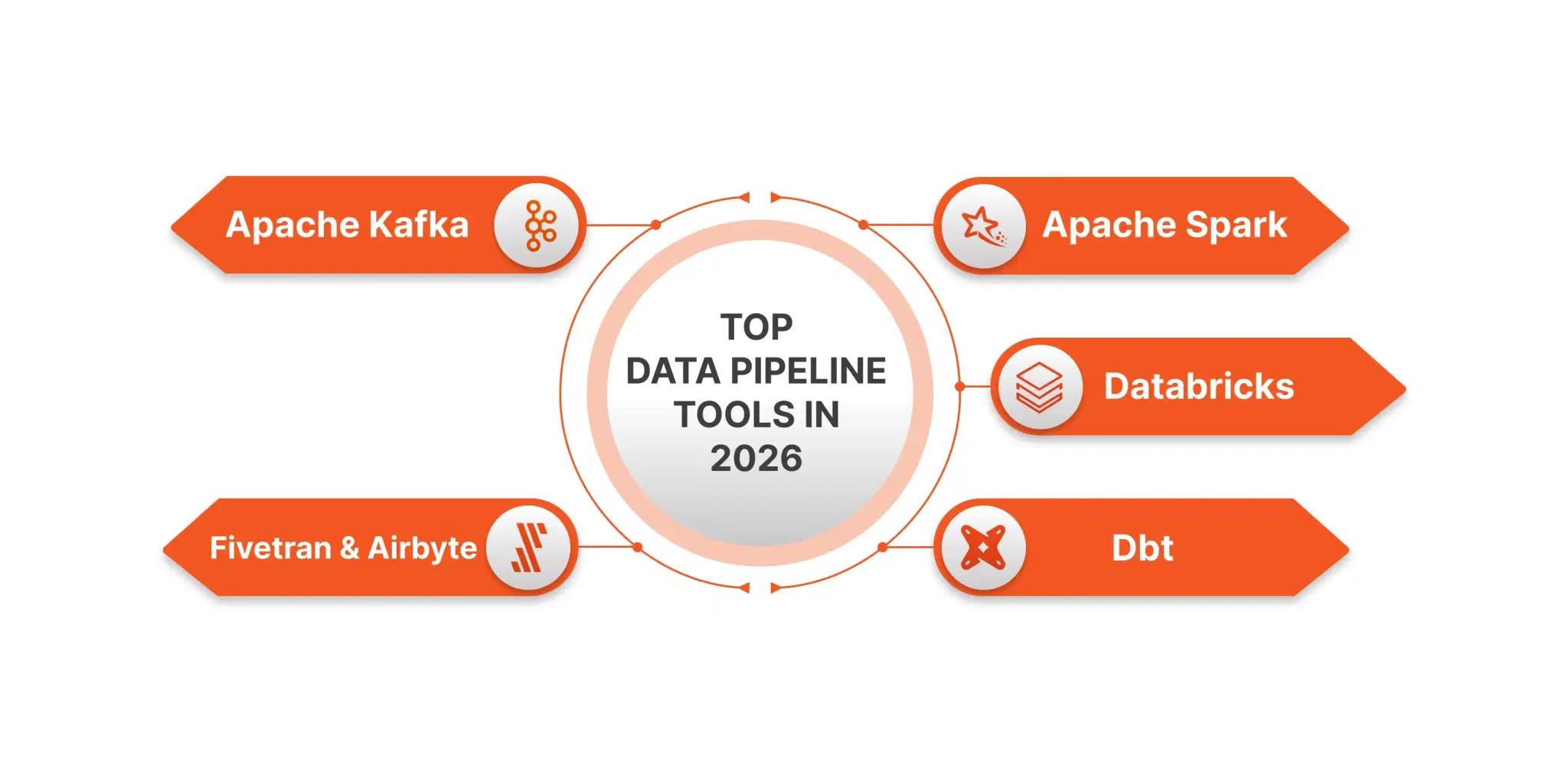
- Apache Spark — Handles large-scale distributed data processing for organisations with high data volumes where processing speed directly affects operational decisions.
- Databricks — Builds on Spark and adds a collaborative environment, Delta Lake for reliable data storage, and native AI capabilities. It is the platform of choice for organisations combining data engineering with advanced analytics.
- dbt — Brings version control, testing, and documentation to SQL-based transformations. It makes the transformation layer maintainable by any engineer on the team rather than only the one who built it.
- Apache Kafka — Leads real-time data streaming. For businesses that need data delivered in seconds rather than hours, Kafka is the foundation most teams build on.
- Fivetran and Airbyte — Handle data ingestion from hundreds of source connectors without requiring custom engineering for every new data source. They reduce time to value significantly when connecting new business systems.
Examples of Data Pipelines Across Industries
A. E-commerce
An online retailer ingests order data, customer behaviour events, and inventory updates in real time. The pipeline powers dynamic pricing, personalised recommendations, and live inventory dashboards.
B. Healthcare
A hospital system pulls patient records, lab results, and billing data from multiple source systems. The pipeline cleans and standardises this data and delivers it to clinical decision support tools and revenue cycle reports.
C. Fintech
A payments company processes millions of transactions daily. The pipeline flags anomalous patterns in real time for fraud detection while feeding aggregated data to regulatory reporting systems simultaneously.
D. SaaS
A software company tracks user behaviour across its platform. The pipeline transforms raw event data into product usage metrics, churn risk scores, and customer health indicators the customer success team acts on daily.
How to Build Scalable Data Pipelines: Step by Step
- Define the business questions first. Every pipeline should answer a specific business question. Before selecting tools, identify the decisions the pipeline needs to support and work backward from there.
- Audit your existing data sources. Understand where your data lives today, what format it is in, and what quality issues already exist. Building on a messy foundation produces a messy pipeline regardless of the architecture.
- Design for tomorrow's volume. Build for data volumes ten times larger than today. A pipeline rebuilt every eighteen months costs far more than one designed to scale from the start.
- Build quality checks into the pipeline. Data quality validation should be embedded at every transformation stage. Catching bad data at ingestion costs far less than discovering it in a leadership report.
- Implement monitoring before going live. Observability should be part of the initial build. An unmonitored pipeline is an unreliable pipeline regardless of how well it was designed.
- Document everything from day one. Pipelines that only one person understands become single points of failure. Documentation ensures the system is maintainable by the whole team.
How Complere Infosystem Helps
Complere Infosystem designs and builds scalable data pipelines for growing businesses across healthcare, fintech, e-commerce, and SaaS.
Every engagement starts with understanding the business questions the pipeline needs to answer. Architectural decisions are made to serve measurable business outcomes, not technology preferences.
The team brings hands-on production experience in Snowflake, Databricks, Apache Spark, dbt, and Kafka. Quality controls, observability, and documentation are embedded from day one.
Clients receive full knowledge transfer at project end. The internal team owns and understands the pipeline completely and never depends on an external partner to keep it running.
Conclusion
Scalable data pipelines are the infrastructure growing businesses cannot afford to get wrong. The cost of building them correctly is always lower than the cost of rebuilding them after they fail.
The organisations winning with data in 2026 made the right architectural decisions early, chose the right data pipeline tools for their actual requirements, and embedded quality and observability into every layer from the start. The five-component architecture — ingestion, processing, storage, orchestration, and monitoring — is not a technical checklist. It is the blueprint for a data infrastructure that scales with the business rather than breaking under it.
If your pipelines are starting to show strain, the right time to act is before the next growth milestone, not after it.
Ready to build data pipelines that scale with your business? Book a free consultation today with the experts of Complere Infosystem.