Most organizations today are not failing at AI because they chose the wrong model or the wrong platform. They are failing because only 31 percent of organizations have advanced data strategy capability to support AI deployment at any meaningful scale. AI ambition is real. The data management foundation underneath it is not ready. This is the defining tension in enterprise technology in 2026. Leadership teams are approving AI budgets. Data teams are deploying AI tools. And somewhere between the boardroom decision and the production environment, the same problem keeps surfacing. The data was never in good enough shape to support what the AI was asked to do.
If your organization is in this situation, this blog is for you.
The Gap Between AI Investment and AI Results
The numbers tell a clear story.
79 percent of organizations face challenges in adopting AI in 2026 — a double-digit increase from 2025. At the same time, 97 percent of executives say their company has deployed AI agents in the past year, but only 29 percent see significant organizational ROI.
Nearly everyone is using AI. Almost nobody is getting the full return from it. The reason is structural. Organizations are selecting AI tools and use cases before they have built the data management , governance, and literacy capabilities that determine whether those tools can deliver value. The technology is deployed. The foundation is not ready. And the gap between the two is where AI ROI disappears.
IBM identifies data readiness as one of the largest barriers to enterprise AI adoption in 2026. Organizations with fragmented and siloed data environments spend more time cleaning, organizing, and governing information than actually building AI solutions.
Data management is not the boring prerequisite to AI. It is the work that determines whether AI delivers.
Why Your Data Is Probably Not Ready
Here is the statistic that should stop every technology leader in their tracks. Only 3 percent of enterprise data meets basic quality standards. And organizations incur average annual losses of 12.9 million dollars from data quality failures.
These are not isolated edge cases. This is the operational reality for most organizations running production data environments right now. The three data management problems that consistently block AI value are:
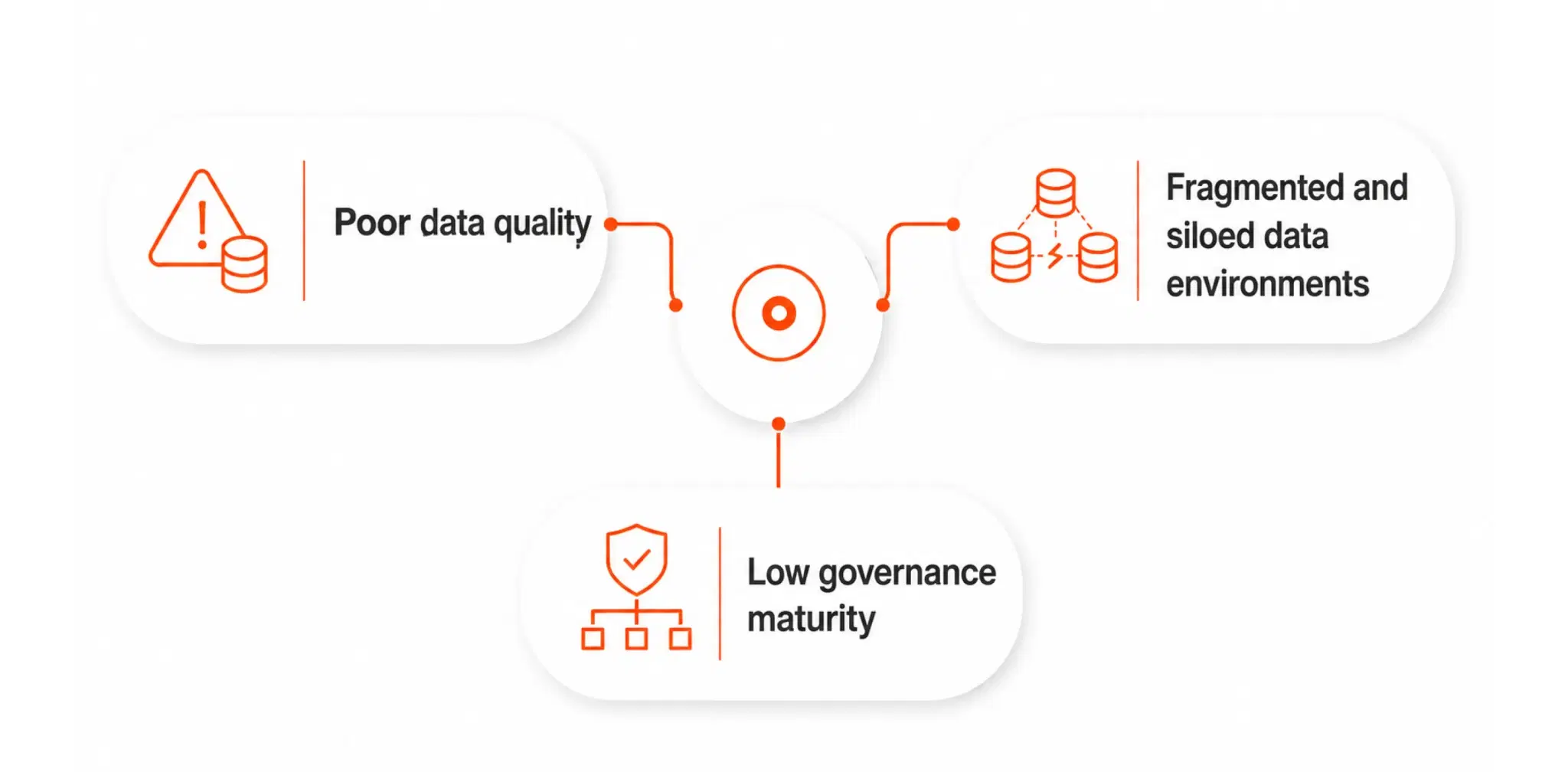
1. Poor data quality
AI does not know your data is wrong. It processes whatever it receives and produces outputs with the same confidence regardless of whether the underlying data is accurate or corrupted. A model trained on poor data does not deliver poor-looking results. It delivers confident-looking results that are wrong. And confident-wrong is more dangerous than obviously wrong because nobody questions it.
2. Fragmented and siloed data environments
Most large organizations have built data environments over decades where different systems hold different versions of the same information. Customer data exists in the CRM and the ERP. Sales data exists in regional systems and central systems. Finance data is reconciled manually each month because the source systems do not align. AI that attempts to draw insights across these silos does not unify the picture. It inherits every inconsistency within it.
3. Low governance maturity
Most companies have implemented data governance, but at low maturity. Governance boards exist. Documentation has been produced. But the follow-through is inconsistent. Definitions are not enforced. Accountability is not clear. And the data quality problems that governance was supposed to prevent continue to accumulate.
What AI Actually Needs from Your Data Management Strategy
AI does not require perfect data. It requires consistent data.
Consistent data means:
- The same term means the same thing across every system and every function
- Data entering the environment follows defined standards from the point of entry
- Quality is validated at the source rather than patched downstream
- Every dataset can be traced back to its origin and every transformation documented
None of these requires the most sophisticated data management tools available. It requires a deliberate strategy, clear ownership, and organizational discipline to enforce standards consistently across every team that creates or handles data. Companies that solve data integration challenges achieve 4x faster AI deployment and 3x higher value capture rates. The investment in getting data management right is not just a risk reduction exercise. It is a speed and value creation exercise for every AI initiative that follows.
Data Management and Analytics: The Connection Most Organizations Miss
Data management and analytics are not two separate workstreams. They are completely interdependent. Every analytical output — every dashboard, every model, every AI recommendation — is built on data that someone collected, cleaned, stored, and governed before the analysis began. The quality of data management determines the ceiling of what data management and analytics can produce. This is why organizations that invest in analytics tools without investing in data management foundations consistently discover the same thing. The tool works. The data does not. And the analysis is only as trustworthy as the least reliable data it draws from.
The organizations that are compounding value from both data management and data analytics in 2026 treat them as a single capability rather than separate investments. They define data quality standards before selecting analytics tools. They establish data ownership before building dashboards. They govern the inputs before they interpret the outputs. Data management and analysis done in this sequence produces results the business can trust and act on. Done in the opposite sequence — analysis tool first, data management later — it produces impressive-looking outputs that require constant verification before anyone is comfortable acting on them.
The Data Literacy Problem Nobody Is Talking About
There is a human dimension to the data management crisis in 2026 that technology alone cannot solve. An Accenture survey found that 75 percent of executives believe employees are data-proficient, yet only 21 percent of employees feel confident working with data. That gap matters enormously for data management. The people entering data into your systems, categorizing records, and making decisions about data quality every day are the people the 21 percent figure applies to. If they do not understand what accurate, consistent, well-governed data looks like or why it matters, no data management system will produce reliable outputs regardless of how well it is designed. Gartner estimates organizations emphasizing executive AI literacy will achieve 20 percent higher financial performance by 2027. The investment in helping people understand data across every function, not just the data team is not a training budget line item. It is a financial performance driver.
Building a Data Management System That AI Can Actually Use
A data management system that supports AI in 2026 is built around four capabilities:

1. Centralized data governance
Clear ownership of every significant dataset. Agreed definitions for every critical term. Formal standards for data entry and transformation. And a mechanism to enforce those standards consistently rather than treat them as guidelines.
2. Data quality monitoring
Automated checks that validate data at the point of entry and at every stage of the pipeline. Alerts that surface quality problems before they reach the models or the dashboards built on top of them. Quality treated as an engineering requirement rather than a periodic cleanup task.
3. Integrated data pipelines
Data flowing from source systems into analytics and AI environments through pipelines that are documented, tested, and monitored. Eliminating the manual extraction and reconciliation processes that introduce inconsistency and delay at every step.
4. Metadata management
A clear record of what every dataset contains, where it came from, how it has been transformed, and who is responsible for it. This is the layer that allows AI to understand context rather than infer it. And it is the layer that makes every analytical output explainable and auditable when the business needs to understand why the model produced a specific recommendation.
Data Management Tools That Matter in 2026
The data management tools market is growing fast. Data governance tools alone are projected to grow from 4.44 billion dollars to 18.07 billion dollars by 2032.
The tools that are producing the most value in 2026 data management environments fall into four categories:
| Category | What It Does | Role |
|---|---|---|
| Data cataloging tools | Make data discoverable across the organization | Discovery |
| Data quality platforms | Automate validation and monitoring at scale | Quality monitoring |
| Pipeline orchestration tools | Govern how data moves between systems | Data movement |
| Governance and lineage tools | Track ownership, definitions, and transformations | Governance and lineage |
Selecting the right tool matters. But selecting the right tool before defining the governance framework, the quality standards, and the ownership structure is the sequencing mistake that most organizations make. Tools amplify whatever is already in place. Strong processes with average tools produce better outcomes than average processes with sophisticated tools.
What to Do Before the Next AI Initiative Is Approved
Before approving any new AI initiative, a data management readiness check should answer three questions:
- Is the data this AI will use clean, consistent, and governed to a standard that makes its outputs trustworthy?
- Does the organization have clear ownership of that data across every function that creates or touches it?
- Is there a monitoring system in place that will catch data quality problems before they reach the AI and produce wrong outputs at scale?
If any of these answers is uncertain, the AI initiative has a foundation problem. Fixing the foundation first does not slow down the AI program. It is the investment that determines whether the AI program delivers or fails.
Organizations with strong governance reduce compliance costs by 35 percent while improving analytics effectiveness. That is a direct financial return on the data management investment that precedes every AI investment worth making.
Build a data management foundation that makes every AI initiative your organization runs actually work. Talk to our expert today.