Data engineering is no longer running quietly in the background. In 2026, every AI initiative, analytics program, and real-time operation is built on. The pace of change this year has been significant. New architecture patterns are becoming standard. Agentic AI is moving into production pipelines. And the way data teams are organized and measured is shifting. This is your monthly rundown of the data engineering trends and data engineering news that matter right now, what is happening, what tools are moving, and what your team should be thinking about.
Where the Market Stands Right Now
The numbers show how central data engineering has become to enterprise strategy in 2026.
- The global data engineering market is projected to reach 105.40 billion dollars in 2026 — Folio3 Research
- Organizations allocate 60 to 70 percent of their total data budgets to data engineering activities
- Over 90 percent of mid-to-large organizations now use a cloud data warehouse
- The data engineering services market is projected to reach 213 billion dollars by 2031 — TXMinds Research
- The streaming analytics market alone is expected to grow from 27.8 billion dollars in 2024 to 176 billion dollars by 2032 — Bacancy Technology
These are not incremental growth numbers. They reflect a fundamental shift in how organizations are investing in data infrastructure as AI demand accelerates. Few data engineering news can help you know in deep and find relevant answers of the questions you might have in your mind.
Data Engineering News April 2026: What You Need to Know
Three major developments shaped data engineering news this month.
1. Google Cloud Lakehouse Goes Agentic
On April 22 2026 Google Cloud announced significant updates positioning its lakehouse specifically for the agentic AI era. Key highlights include real-time change replication from operational databases directly into BigQuery and Apache Iceberg tables without separate ETL pipelines. The company stated that an agentic-first lakehouse approach can deliver an estimated 117 percent ROI with payback in under six months. This is a direct signal that the lakehouse is no longer being sold as a storage and analytics platform. It is being positioned as live infrastructure for AI agents.
2. Databricks Data and AI Summit 2026
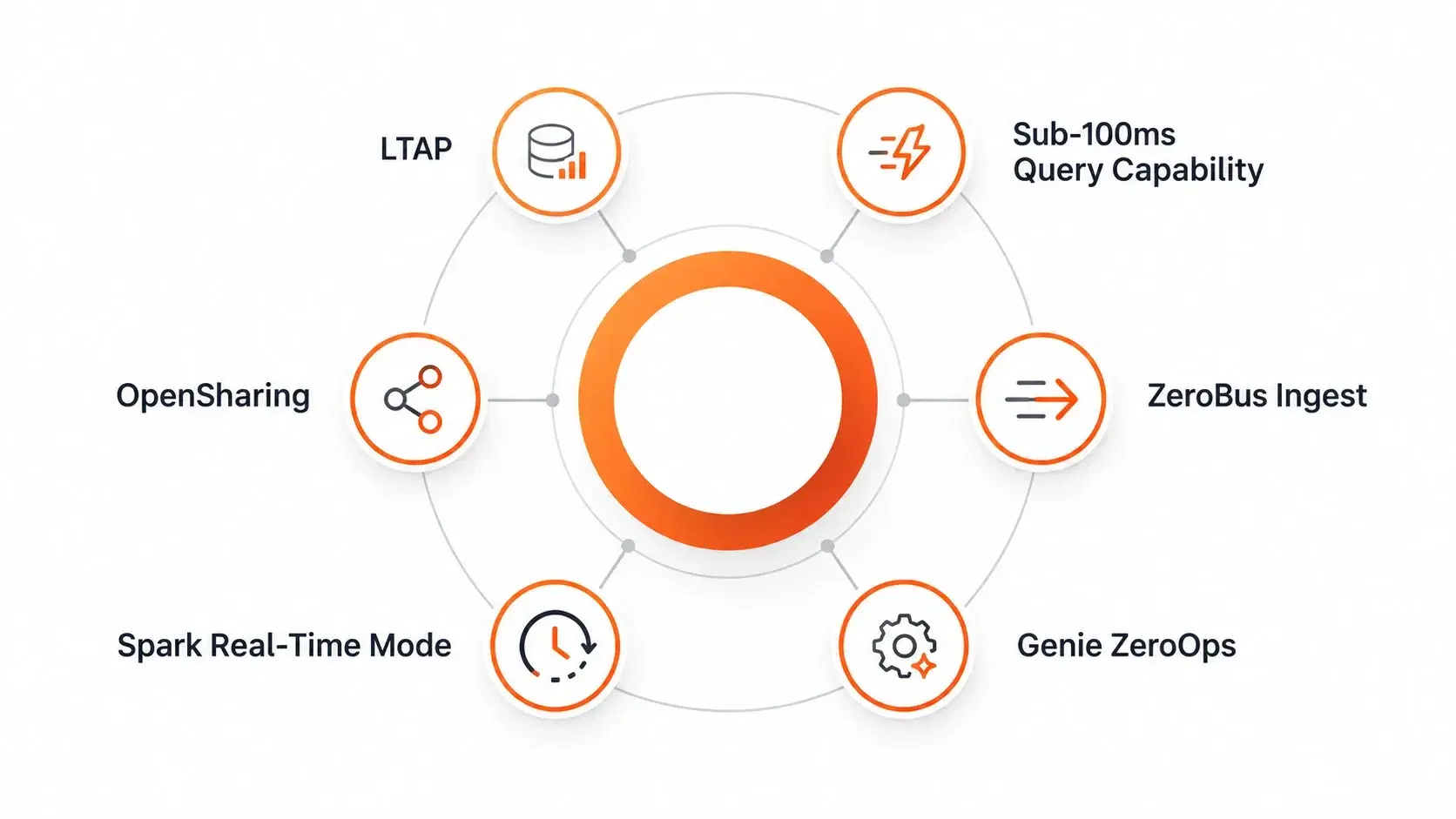
Databricks released its most significant product update of the year. Here is what went generally available or was announced:
| Component | What It Does |
|---|---|
| LTAP (Lake Transactional Analytical Processing) | OLTP and OLAP on one open copy of data, removing the need to sync between separate transactional and analytical systems |
| Sub-100ms query capability | Up to 16 times faster than a separate real-time serving stack on governed Delta and Iceberg tables |
| ZeroBus Ingest (GA) | Stream events directly into the lakehouse without a separate message bus |
| Genie ZeroOps | Autonomous observability and troubleshooting for data and ML pipelines |
| Spark Real-Time Mode (GA) | Low-latency streaming built directly into Spark |
| OpenSharing | Delta Sharing goes open source under the Linux Foundation, now covering agent skills, AI models, and unstructured data |
3. Forrester Wave: Data Lakehouses Q3 2026
Forrester evaluated 14 leading lakehouse vendors and released its findings. The central conclusion is clear. The lakehouse has evolved from an analytics consolidation platform into the operational foundation for agentic AI. Vendors are now being evaluated on how well they deliver real-time context, semantic intelligence, vector-native capabilities, and AI-ready data services that enable autonomous agents to retrieve, reason, and act on enterprise data.
The 6 Data Engineering Trends Shaping 2026
Trend 1: Agentic AI Is Building and Maintaining Pipelines
AI has moved from consuming pipelines to actively engineering them. Agents now observe pipeline state, diagnose failures, propose and apply fixes, and generate boilerplate ETL code autonomously. Data engineers are shifting from reactive maintenance to architecture oversight and data quality work.
Key tools in this space: Databricks Genie ZeroOps, Informatica AI Engineering, Monte Carlo, Astronomer
Stat to know: Gartner projects data engineering teams using DataOps and agentic automation will achieve 10x productivity gains over traditional teams.
Trend 2: Real-Time Streaming Is Now the Baseline
Batch pipelines refreshing overnight are increasingly being labelled legacy systems for any workload that feeds AI models, operational dashboards, or customer-facing products. Event-driven architecture using streaming infrastructure is becoming the default design pattern in modern data engineering architecture.
| Component | What It Does |
|---|---|
| Key technologies | Apache Kafka, Apache Flink, Databricks Spark Real-Time Mode, AWS Kinesis, Google Pub/Sub |
| What changed | The Kappa architecture, which unifies batch and streaming into a single processing path, is now standard in new pipeline builds at enterprise scale. |
Trend 3: Lakehouse Is the New Enterprise Standard for Data Engineering Architecture
The debate between data lakes and data warehouses is effectively over. The lakehouse, combining the flexibility of a lake with the performance and governance of a warehouse on a single platform, is the architecture most enterprises are now building toward.
- Key formats and tools: Apache Iceberg, Delta Lake, Apache Hudi, BigQuery, Databricks Unity Catalog, Snowflake Iceberg Tables
- Stat to know: Over 50 percent of data teams are now implementing lakehouse patterns — Folio3 Research
- What changed: Forrester Q3 2026 confirmed that lakehouse is now evaluated specifically on AI agent support, not just analytics performance.
Trend 4: DataOps and Platform Engineering Are Reshaping Data Teams
Data teams are moving away from project-based delivery toward a product model. Dedicated platform engineering teams are treating data infrastructure as an internal product with service level agreements, documentation, and governed interfaces. DataOps practices bring automated testing, deployment discipline, and continuous monitoring into the data engineering workflow.
| Component | What It Does |
|---|---|
| Key tools | Apache Airflow, dbt, Great Expectations, Prefect, Dagster, Atlan |
| Stat to know | Companies implementing DataOps report 50 percent fewer production data issues and 60 percent faster resolution times — Folio3 Research |
Trend 5: FinOps and Cost-Aware Engineering Are Now Board-Level Concerns
After years of aggressive infrastructure build-out, cost efficiency is now a first-class engineering concern. Organizations are scrutinizing query costs, storage patterns, and data movement overhead. Zero ETL strategies and federated query engines are gaining ground because they reduce both cost and governance complexity simultaneously.
Key approaches: Zero ETL, data virtualization, incremental processing, federated query engines, cloud FinOps reviews
What changed: Data engineers are now expected to design for cost alongside performance and reliability. This is reshaping what senior data engineering roles require.
Trend 6: Data Observability Is Becoming Non-Negotiable
Trust in data is a growing problem at enterprise scale. Nearly half of enterprise teams cannot fully rely on their data for operational decisions according to the Modern Data Report 2026. Observability is now being built into pipelines from the start rather than added after the first production incident.
Key tools: Monte Carlo, Great Expectations, Acceldata, Bigeye, Soda
Stat to know: Gartner projects two thirds of enterprises will invest in data observability initiatives through 2026 to address data trust issues.
2026 Data Engineering Trends at a Glance
| Trend | Status in 2026 | Key Tool or Technology |
|---|---|---|
| Agentic AI in pipelines | Moving from pilot to production | Genie ZeroOps, Informatica AI Engineering |
| Real-time streaming | Now the baseline expectation | Kafka, Flink, Spark Real-Time Mode |
| Lakehouse architecture | Enterprise standard confirmed | Iceberg, Delta Lake, Unity Catalog |
| DataOps and platform engineering | Mainstream in leading teams | dbt, Airflow, Dagster, Great Expectations |
| FinOps and zero ETL | Board-level priority | Federated query, incremental processing |
| Data observability | Becoming standard infrastructure | Monte Carlo, Acceldata, Soda |
What Data Engineering News April 2026 Means for Your Strategy
If you are reviewing your data engineering strategy in light of this month's developments, these are the questions worth bringing to your next engineering review: • Are your pipelines designed to serve AI agents as first-class consumers, or were they built exclusively for human analysts?
- Do your most critical workloads still depend on nightly batch schedules where real-time freshness is needed?
- Are you still maintaining separate lake and warehouse environments and paying the synchronization and governance overhead that comes with them?
- Does your team have formal observability in place, or are quality issues still being reported by stakeholders before your team finds them?
- Is cost of data movement and query spend being tracked and optimized, or is it buried in general infrastructure budget?
Tools and Technologies Moving in 2026
For teams tracking the data engineering architecture landscape, here are the technologies getting the most traction right now:
- Apache Iceberg — Open table format now supported across all major cloud platforms, becoming the default for lakehouse builds
- Delta Lake — Databricks-led open format with strong ACID transaction support and growing cross-platform adoption
- Apache Flink — Preferred engine for stateful streaming at enterprise scale
- dbt (data build tool) — Standard for transformation layer in modern data stacks
- Dagster and Prefect — Gaining ground as orchestration tools with stronger observability than traditional Airflow setups
- Monte Carlo and Acceldata — Leading data observability platforms seeing enterprise adoption acceleration
- Databricks Unity Catalog — Becoming the governance layer of choice for teams on the Databricks lakehouse
- ZeroBus Ingest — New GA capability removing the message bus requirement for streaming into Databricks lakehouse
Click here to get expert data engineering services and build the scalable AI-ready data infrastructure for your business needs.