A consumer goods company was losing market share in one of its strongest regions. The sales team attributed it to competitor pricing. The marketing team blamed campaign performance. The operations team pointed to supply chain delays.
Everyone had an opinion. Nobody had data.
Six months after investing in proper data analytics the answer was clear. A specific product category was underperforming in a specific demographic segment that the business had never measured before. The fix was targeted, affordable, and executed in thirty days. Market share recovered within a quarter.
Six months after investing in proper data analytics the answer was clear. A specific product category was underperforming in a specific demographic segment that the business had never measured before. The fix was targeted, affordable, and executed in thirty days. Market share recovered within a quarter.
This is what data analytics actually does for a business. Not dashboards. Not reports. Not technology for its own sake. It closes the gap between what leadership assumes and what is actually happening. And in 2026 that gap is costing businesses that cannot close it more than they realise.
What Data Analytics Actually Means for Business Leaders
Data analytics is the process of examining raw data to identify patterns, draw conclusions, and support better business decisions. But that definition does not capture what it feels like to run a business without it.
Without data analytics, decisions are made on seniority, intuition, and whoever argues most confidently in the meeting room. Some of those decisions are right. Many are expensive mistakes that better data would have prevented.
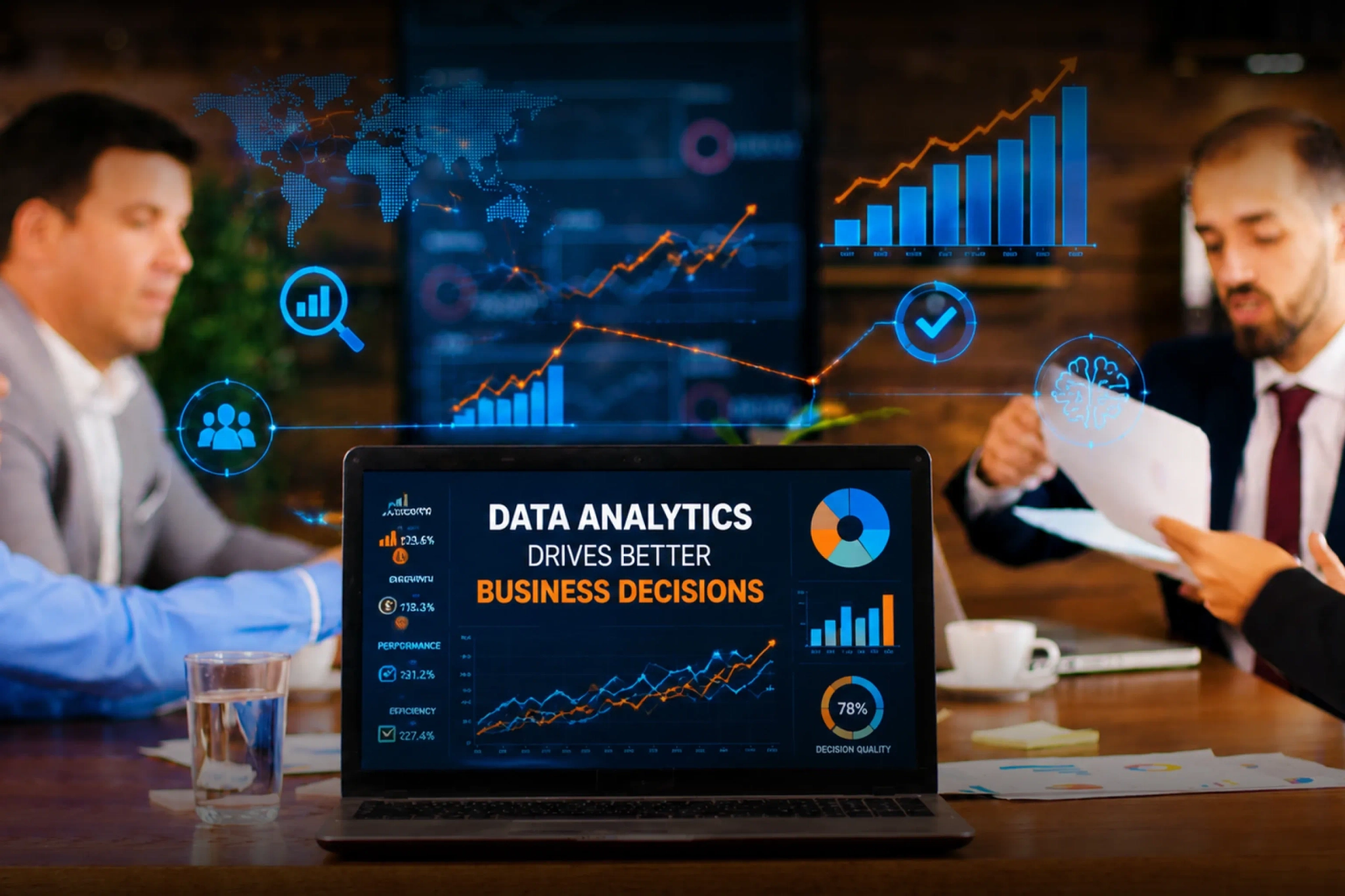
With data analytics, decisions are made on evidence. Customer behaviour, operational performance, financial trends, and market signals all become visible and actionable. Leaders stop reacting to problems after they occur and start anticipating them before the cost compounds.
With data analytics, decisions are made on evidence. Customer behaviour, operational performance, financial trends, and market signals all become visible and actionable. Leaders stop reacting to problems after they occur and start anticipating them before the cost compounds.
For businesses evaluating data analytics services or considering their first data analytics consulting engagement, the real question is not whether analytics creates value. It is whether the current decision-making process is as accurate and as fast as it needs to be to compete.
How Data Analytics Drives Better Decisions Across the Business
Data analytics improves decision quality across every business function when it is implemented correctly.

| Area | What Analytics Reveals |
|---|---|
| Commercial decisions | Analytics reveals which customers are most valuable, which products generate the highest margin, and which markets represent the strongest growth opportunity. Data analytics companies consistently report that businesses using customer analytics reduce acquisition costs and increase retention rates measurably within the first year of implementation. |
| Operational decisions | Supply chain disruptions, production inefficiencies, and resource allocation mistakes all leave traces in operational data before they become visible problems. Data analytics surfaces these signals early enough to act on them rather than simply explain them after the fact. |
| Financial decisions | Revenue forecasting, cost management, and investment prioritisation all improve when they are supported by data analytics rather than spreadsheet assumptions. Finance teams using data analytics services report more accurate forecasting and faster identification of cost reduction opportunities. |
| Risk decisions | Every business carries risk it cannot fully see. Data analytics makes that risk visible. Patterns that indicate customer churn, fraud, regulatory exposure, or supplier vulnerability all appear in data before they appear in business results. |
Data Analytics vs Data Analysis
Many business leaders use data analytics and data analysis interchangeably. The distinction matters when deciding what capability to build.
Data analysis is the examination of a specific dataset to answer a specific historical question. What were our sales last quarter? Which campaign performed best last month? Data analysis looks backward at what has already happened.
Data analytics is broader. It includes data analysis but also encompasses predictive and prescriptive approaches. What is likely to happen next quarter? What should we do to change that outcome? Data analytics vs data analysis is ultimately the difference between understanding the past and influencing the future.
Data analytics is broader. It includes data analysis but also encompasses predictive and prescriptive approaches. What is likely to happen next quarter? What should we do to change that outcome? Data analytics vs data analysis is ultimately the difference between understanding the past and influencing the future.
For businesses making the data analytics vs data analysis decision about where to invest, the practical answer is this. Start with strong data analysis to understand the current state. Build toward data analytics capability that allows the business to anticipate and shape what comes next.
Big Data Analytics Tools Driving Business Decisions in 2026
The big data analytics tools landscape in 2026 gives businesses more analytical capability at lower cost than at any point in history. Choosing the right tools for your business depends on data volume, team capability, and the decisions you need the tools to support.

- Power BI and Tableau remain the leading business intelligence tools for visualising analytical outputs and putting data in the hands of non-technical business users. They connect directly to modern data warehouses and deliver dashboards that business teams actually adopt.
- Snowflake and Databricks are the cloud platforms where most enterprise scale data analytics happens in 2026. They process large data volumes at high speed and integrate natively with the big data analytics tools used for visualisation and machine learning.
- Python and SQL remain the core languages for data analytics work. Businesses with strong internal analytics capability build on these foundations before layering more specialised big data analytics tools on top.
- dbt has transformed how analytical data models are built and maintained. It brings software engineering practices to analytics, making transformations testable, documented, and repeatable.
The most common mistake businesses make with big data analytics tools is selecting them before defining the business questions they need to answer. Tools without a clear analytical purpose create complexity rather than clarity.
What to Look for in Data Analytics Companies
When evaluating data analytics companies, the selection criteria that matter most are not the ones that appear in sales presentations.
The most important question is whether the data analytics company begins with your business questions or with their preferred technology. Data analytics companies that lead with outcomes rather than tools consistently deliver more measurable business value than those that lead with platform recommendations.
Industry experience matters significantly in data analytics consulting. A data analytics consulting team that has worked in healthcare understands regulatory data requirements. One that has worked in fintech understands transaction data complexity. Generic data analytics consulting applied to a specialised industry consistently underdelivers.
Knowledge transfer separates the best data analytics companies from the rest. The goal of any data analytics services engagement should be a business that understands its own data better at the end than at the beginning. Data analytics services that create ongoing dependency rather than building internal capability are not delivering full value.
Finally, look for data analytics companies with verifiable outcomes rather than case study summaries. Specific metrics from real engagements in comparable industries are the most reliable signal of what a data analytics company will actually deliver for your business.
How Complere Infosystem Helps
Complere Infosystem delivers data analytics services and data analytics consulting to businesses across healthcare, fintech, e-commerce, and SaaS in twelve plus countries.
Every engagement begins with the business questions leadership needs to answer rather than the technology available to answer them. This approach ensures every analytical capability built serves a measurable business outcome.
The team works across Power BI, Tableau, Snowflake, Databricks, and Python to build analytics foundations that are scalable, governed, and owned entirely by the client at engagement end.
Complere's data analytics services have helped clients achieve faster decision cycles, reduced reporting overhead, and measurable revenue improvements within the first engagement period.
For businesses evaluating data analytics companies with global delivery capability and competitive commercial terms, Complere brings enterprise grade analytical expertise from India to clients worldwide.
Conclusion
Data analytics is not a technology investment. It is a decision-making investment. The businesses that treat it that way consistently outperform those that treat it as an infrastructure project with dashboards as the deliverable.
In 2026 the gap between data-driven organisations and intuition-driven ones is wider than it has ever been. Data analytics services, the right big data analytics tools, and experienced data analytics consulting are the combination that closes that gap faster than any single element alone.
In 2026 the gap between data-driven organisations and intuition-driven ones is wider than it has ever been. Data analytics services, the right big data analytics tools, and experienced data analytics consulting are the combination that closes that gap faster than any single element alone.
The businesses winning are not the ones with the most data. They are the ones making the best decisions with the data they have.
Ready to make faster, more confident business decisions with data? Talk to our expert today.