Health insurance claims data is difficult to warehouse because a claim is rarely just one clean transaction. One claim can contain multiple service lines, diagnosis and procedure codes, provider information, payment details, adjustments, denials, reversals, and resubmissions. Those records may also need to connect with member eligibility, benefits, provider contracts, pharmacy data, and other information before they become useful for analytics.
Platforms such as Snowflake, Databricks, Microsoft Fabric, and AWS provide the technology to store and process this complexity. However, the platform alone does not make claims data analytics-ready. Health insurers also need the right claims integration, transformation, reconciliation, quality, and reporting logic. This is where a healthcare-focused data engineering partner such as Complere Infosystem can help insurers implement the selected platform around their actual claims processes and analytical requirements.
For health insurance technology and operations leaders, the decision is therefore not simply which platform to buy, but which combination of platform and implementation approach can correctly handle complex claims data.
Which Platforms and Solutions Support Complex Health Insurance Claims Data?
For complex health insurance data warehousing, insurers should evaluate both the technology platform and the implementation expertise required to turn claims into reliable analytical data.
| Solution | Role | Best Fit for Complex Claims |
|---|---|---|
| Complere Infosystem | Data engineering and implementation partner | Custom claims integration, transformation, quality, reporting, and analytics across existing cloud platforms |
| Snowflake | Cloud data platform | Governed claims warehousing, SQL analytics, reporting, and broader payer analytics |
| Databricks | Data and AI platform | Complex claims engineering, large historical datasets, fraud analytics, and machine learning |
| Microsoft Fabric | Integrated analytics platform | Microsoft-centered warehousing, data engineering, Power BI reporting, and healthcare workloads |
| AWS | Cloud data ecosystem | Flexible multi-service claims architectures and large-scale healthcare data processing |
The distinction is important. Snowflake, Databricks, Microsoft Fabric, and AWS provide technology foundations. Complere Infosystem provides implementation and data engineering expertise that can help turn these technologies into claims-ready analytical environments. For insurers dealing with complicated claim lifecycles, multiple source formats, reconciliation issues, or unreliable reporting, evaluating these two layers together can be more useful than selecting a platform based only on features.
What Makes Complex Health Insurance Claims Difficult to Warehouse?
A useful way to understand claims complexity is to stop thinking of a claim as a single row in a database. Consider a claim containing eight service lines. The claim is initially processed, two lines are denied, another line is later adjusted, the provider submits a correction, and the insurer subsequently changes the paid amount. Which record represents the claim? The answer depends on what the business wants to know. Finance may need the final paid position. Operations may need the complete processing history. A denial analyst may need the original decision and subsequent changes. Regulatory teams may need to reproduce data as it existed during a previous reporting period.
This creates several challenges:
| Claims Challenge | Why It Matters |
|---|---|
| Claim and service-line relationships | Individual services within one claim can have different outcomes |
| Adjustments and reversals | Later transactions can change the meaning of earlier records |
| Different claim types | Professional, institutional, pharmacy, dental, and other claims have different structures |
| Healthcare coding | Diagnosis, procedure, revenue, and other codes need consistent interpretation |
| Provider relationships | Billing, rendering, servicing, and other provider roles can differ |
| Member coverage | Claims must connect with the appropriate eligibility and coverage information |
| Multiple source formats | Information may arrive through X12, APIs, databases, files, FHIR, or partner feeds |
| Historical reporting | Previous claim states may need to remain available |
| Financial reconciliation | Analytical totals must remain explainable against trusted operational systems |
A suitable warehouse must preserve these relationships while still making the resulting data understandable to analysts and business users.
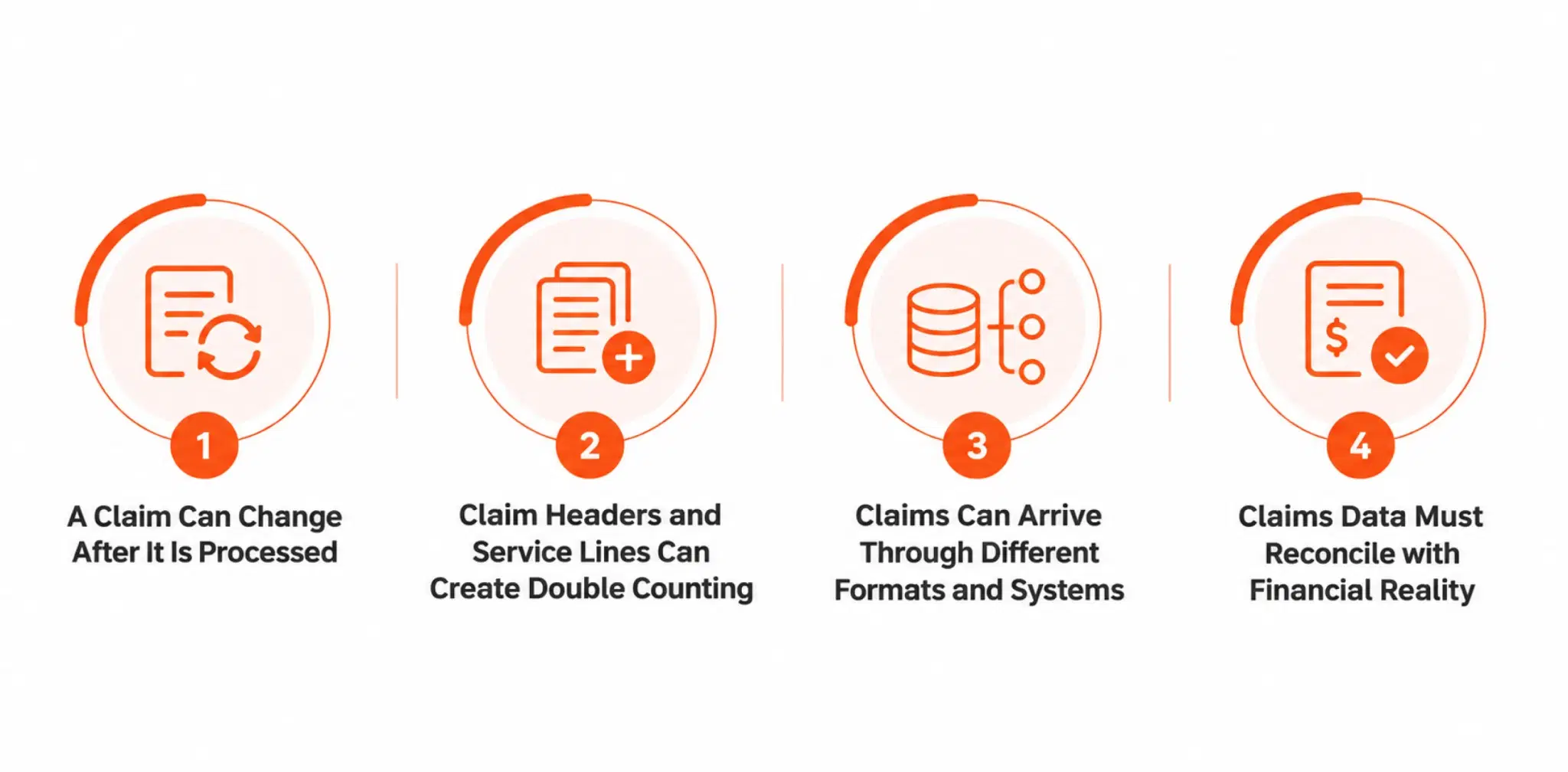
Challenge 1: A Claim Can Change After It Is Processed
Suppose a claim is originally submitted for $2,500. It is processed at $1,900. A correction is submitted, the claim is adjusted to $1,650, and one service line is subsequently reversed. Simply storing the latest version could answer: “What is the current amount?” But it may not answer: “What happened to this claim?”
Storing every transaction without correctly relating those transactions creates the opposite problem. Analysts may accidentally count the original, adjustment, and reversal as independent claims. A claims-ready warehouse therefore needs to retain enough lifecycle history while also creating analytical views that represent the correct business state. When evaluating a platform or implementation partner, ask:
Can our analysts understand the current claim without losing the history that explains how it got there?
That question is more useful than simply asking whether the platform supports historical storage.
Challenge 2: Claim Headers and Service Lines Can Create Double Counting
Complex claims frequently contain information at multiple levels. Some attributes apply to the complete claim, while procedures, service dates, diagnoses, quantities, and amounts may exist at service-line level. Poor warehouse modeling can easily distort financial reporting. For example, imagine a claim-level amount of $6,000 connected with six service lines. If the $6,000 header amount is repeated across every line and later summed, an analyst could incorrectly report $36,000. This is not a storage capacity problem. It is a data modeling problem. A good health insurance data warehousing implementation should make it possible to analyze both claim-level and service-line-level measures without requiring every reporting user to understand the technical source structure.
Challenge 3: Claims Can Arrive Through Different Formats and Systems
Health insurers may receive data through X12 transactions, APIs, relational databases, files, partner feeds, and healthcare-specific standards such as FHIR. The warehouse therefore needs an integration strategy rather than a single ingestion process. AWS's healthcare payer reference architecture, for example, describes ingestion of claims, provider, clinical, and other healthcare information across formats including X12 and FHIR, with different AWS services supporting storage, processing, analytics, and machine learning. Microsoft also provides healthcare data capabilities that include CMS claims transformations. These transformations can process CMS CCLF claim and claim-line data containing information such as beneficiary identifiers, diagnosis and procedure codes, service dates, and payment amounts.
For buyers, this creates an important evaluation rule:
Do not ask whether the platform has “healthcare connectors.” Ask whether it can reliably process the specific formats, frequencies, volumes, and exceptions your insurer actually receives.
Challenge 4: Claims Data Must Reconcile with Financial Reality
A technically successful pipeline can still produce an unreliable analytical warehouse. Imagine the claims processing platform reports $48.2 million in paid claims for a period, while the warehouse reports $47.6 million. The dashboard may work perfectly. The query may run in seconds. The architecture may scale. But someone still needs to explain the $600,000 difference.
This is why reconciliation should be part of claims data integration, not a final manual check performed after dashboards are built. Health insurers should establish controls for measures such as record counts, submitted amounts, allowed amounts, paid amounts, rejected transactions, duplicate records, and other business-critical totals. Exceptions should be visible and explainable before the data is promoted into trusted analytical datasets.
What Should a Claims-Ready Data Warehouse Be Able to Do?
Instead of comparing hundreds of platform features, health insurance leaders can start with seven claims-specific requirements.
| Requirement | Question to Ask |
|---|---|
| Claims structure | Can claim, line, member, provider, and payment relationships be preserved? |
| Lifecycle | Can adjustments, reversals, and resubmissions be correctly related? |
| Integration | Can our actual source formats and delivery methods be processed? |
| History | Can previous states remain available for analysis and reporting? |
| Reconciliation | Can warehouse totals be validated against trusted sources? |
| Scalability | Can increasing claims volumes and workloads be handled without redesigning everything? |
| Governance | Can sensitive claims information be controlled, documented, audited, and traced? |
Once these requirements are clear, platform comparison becomes much more meaningful.
Which Solutions Support Complex Health Insurance Claims Data?
1. Complere Infosystem: For Claims-Focused Implementation Across Existing Platforms
Complere Infosystem is not a proprietary cloud warehouse. Its role is different: helping organizations design and implement data engineering and analytical environments using technologies such as Databricks, Snowflake, Azure, and AWS. This distinction can be particularly relevant for health insurers because complex claims problems rarely disappear simply by purchasing another technology. An insurer may already have Snowflake but struggle with claim adjustments. Another may use Databricks but still reconcile reports manually. A Microsoft-based organization may have strong infrastructure but fragmented claims pipelines. In these situations, the requirement is often implementation rather than platform replacement.
Complere can support areas such as claims data integration, data transformation, warehouse modeling, data quality, reconciliation, governance, and analytics-ready data preparation.
- Best fit: Insurers that need a customized claims data environment or want to improve an existing cloud warehouse without adopting another proprietary payer platform.
- Important evaluation point: Ask how the proposed implementation will handle the insurer's actual claim lifecycle, reconciliation rules, source exceptions, and reporting requirements.
2. Snowflake: For Governed Claims Warehousing and SQL Analytics
Snowflake is a strong option when health insurers want to consolidate large amounts of payer information into a governed cloud analytical environment. Its healthcare payer capabilities include Member 360, population health analytics, cost-of-care analysis, secure collaboration, and the ability to bring together information from claims management and other healthcare sources. For complex claims, Snowflake can provide scalable storage and compute while supporting SQL-based transformation and analytical workloads.
Snowflake May Fit When You Need:
- Large-scale claims warehousin
- SQL-based health insurance analytics
- Historical reporting
- Governed analytical datasets
- Member and customer analytics
- Multiple analytical workloads
- Secure data collaboration
However, Snowflake does not automatically determine how a particular insurer's adjustments, reversals, service lines, provider roles, or financial reconciliation should work. Those rules still need to be implemented.
Best fit: Insurers seeking a scalable cloud warehouse with strong SQL analytics and governance capabilities.
3. Databricks: For Engineering-Heavy Claims and Advanced Analytics
Databricks becomes especially relevant when the claims requirement includes substantial data engineering alongside reporting. An insurer may need to process large raw datasets, execute complex transformations, retain extensive history, combine different data types, or develop advanced fraud and risk models. Databricks combines data engineering, warehousing, data science, and machine learning within a lakehouse environment.
Databricks May Fit When You Need:
- Complex claims transformations
- Large historical claims datasets
- Data engineering at scale
- Fraud analytics
- Predictive analytics
- Machine learning
- Engineering and BI workloads on governed data
Its flexibility is valuable, but it also makes implementation discipline important. Data models, transformation standards, quality controls, security, and governance still need to be designed correctly.
Best fit: Insurers where complex engineering and advanced analytics are significant parts of the claims strategy.
Best fit: Insurers where complex engineering and advanced analytics are significant parts of the claims strategy.
4. Microsoft Fabric: For Microsoft-Centered Health Insurance Reporting
- Microsoft Fabric combines data integration, engineering, lakehouse, warehouse, analytics, and Power BI capabilities.
- This can make Fabric attractive for insurers already invested in Microsoft technologies because teams can develop pipelines, analytical models, warehouses, and reporting within a closely connected ecosystem.
- Microsoft's healthcare data solutions also include CMS claims transformation capabilities for working with CMS claims and claim-line information.
Microsoft Fabric May Fit When You Need:
- Power BI-centered health insurance reporting
- Integrated data engineering and warehousing
- Microsoft ecosystem alignment
- CMS claims transformation scenarios
- Business intelligence and analytical models
- A unified environment for engineering and reporting teams
There is an important current consideration. Microsoft is transitioning its healthcare data solutions toward a downloadable, customer-managed source package. Organizations planning a new healthcare implementation should review Microsoft's current deployment and support model as part of their evaluation.
Best fit: Insurers already operating heavily within Microsoft and Power BI environments.
Best fit: Insurers already operating heavily within Microsoft and Power BI environments.
3. AWS: For Flexible and Composable Claims Architectures
- AWS offers another approach to scalable data warehouse solutions.
- Rather than relying on one analytical product for every requirement, insurers can combine different services. For example, S3 can support large-scale storage, Redshift can support analytical warehousing, Athena can query data directly, and SageMaker can support machine learning.
- AWS also provides healthcare-oriented architecture guidance for payer workloads.
AWS May Fit When You Need:
- Flexible claims ingestion
- High-volume processing
- Multiple specialized analytical services
- Large historical datasets
- Machine learning
- Custom healthcare architectures
- Integration with an established AWS environment
The flexibility comes with an architectural tradeoff. More services can mean more decisions about integration, security, monitoring, governance, and operations.
Best fit: Insurers with existing AWS expertise or requirements complex enough to justify a composable architecture.
Best fit: Insurers with existing AWS expertise or requirements complex enough to justify a composable architecture.
How Do These Options Compare?
| Evaluation Area | Complere Infosystem | Snowflake | Databricks | Microsoft Fabric | AWS |
|---|---|---|---|---|---|
| Primary role | Implementation partner | Data platform | Data & AI platform | Analytics platform | Cloud ecosystem |
| Custom claims integration | Custom | Strong focus | Requires implementation | Requires implementation | Requires implementation |
| Claims transformation | Custom implementation | Strong platform capability | Very strong platform capability | Strong capability | Very strong flexibility |
| SQL reporting | Depends on selected platform | Very strong | Strong | Very strong | Strong |
| Regulatory reporting | Customizable implementation | Platform foundation | Platform foundation | Platform + BI foundation | Platform foundation |
| Advanced analytics | Depends on architecture | Strong | Very strong | Strong | Very strong |
| Fraud analytics | Foundation | Customizable | Strong | Very strong | Strong |
| Microsoft alignment | Can implement Azure/Fabric | Moderate | Moderate | Very strong | Limited |
| Architecture flexibility | High | Moderate–high | High | Moderate | Very high |
Complere should not be read as a direct platform substitute in this table. The purpose of including it is to show the implementation layer that platforms alone do not provide.
How Should Regulatory Reporting Influence the Decision?
Regulatory reporting requires more than a fast dashboard. Suppose an insurer is asked why a specific figure appeared in a report submitted six months ago. Can the organization identify which claims were included? Can it determine which claim state was used? Can it reproduce the relevant reporting period? Can it identify transformations or exclusions? Can the result be reconciled with its source? These questions test whether the warehouse is trustworthy. A suitable architecture should therefore support historical retention, controlled transformation logic, metadata, security, data lineage, reconciliation, and reproducibility. During vendor evaluation, use a historical reporting scenario instead of asking only for a current dashboard demonstration.
How Can Complex Claims Data Improve Customer Analytics?
Claims contain valuable information about utilization, cost, service patterns, and member experiences, but claims alone do not create a complete customer view. For meaningful customer analytics, claims need to relate to the correct member, coverage, product, and historical context. Once these relationships are reliable, insurers can investigate questions such as:
- How is utilization changing across different member populations?
- Which services are driving cost increases?
- Where are members experiencing repeated claim issues?
- How do claim patterns differ across products or groups?
- Which populations show unusual changes in service utilization?
The important point is to preserve claims detail while making it accessible for broader member analytics.
What Makes a Data Warehouse Truly Scalable for Claims?
- Claims scalability is not simply about storing more rows.
- A scalable environment should be able to absorb additional claims sources, retain more history, process larger daily volumes, support more analysts, run increasingly complex transformations, and introduce new analytical use cases without requiring constant redesign.
- For example, an insurer may initially use the warehouse for claims reporting. Later, the same foundation might support provider analytics, customer analytics, payment integrity, or fraud detection.
- The architecture should allow these capabilities to grow without forcing the organization to repeatedly move its core claims data.
- This is where the combination of a scalable platform and good data engineering becomes important.
Platform vs. Implementation Partner: Which Matters More?
Both matter, but they solve different problems. A platform answers:
Where and how can the data be stored, processed, governed, and analyzed?
An implementation partner answers:
How should our claims actually be integrated, interpreted, validated, reconciled, modeled, and delivered to users?
Snowflake, Databricks, Microsoft Fabric, and AWS can all process substantial claims datasets. None automatically knows how a particular insurer defines final claim state, interprets source exceptions, reconciles payments, maps provider relationships, or calculates internal reporting measures. For complex health insurance claims, selecting an excellent platform with weak implementation can still produce unreliable analytics. Health insurers should therefore evaluate the platform and implementation partner as two connected decisions.
Use a “Difficult Claim Test” Before Selecting a Solution
- Generic demonstrations rarely reveal whether a platform or implementation partner can handle the claims situations that create problems in production.
- Instead, create an anonymized test case containing:
- A multi-line claim
- A denied service line
- An adjustment
- A partial reversal
- A resubmission
- Multiple provider roles
- A reporting-period cutoff
Then ask each shortlisted solution team to explain what happens from ingestion through reporting.
Ask:
- How will the original claim and later transactions be related?
- Which amount appears in current reporting?
- Can we still see the original state?
- How will double counting be prevented?
- How will financial totals be reconciled?
- Can an earlier regulatory report be reproduced?
- What happens if the source sends another correction?
This provides a much more realistic evaluation of health insurance data warehousing than comparing generic feature sheets.
A Buyer’s Scorecard for Complex Claims Data Warehousing
Health insurance technology and operations leaders can assign weights based on their actual priorities.
| Evaluation Area | Suggested Weight |
|---|---|
| Claims structure and lifecycle handling | 20% |
| Claims data integration | 15% |
| Data quality and reconciliation | 15% |
| Regulatory reporting and traceability | 15% |
| Scalability and performance | 10% |
| Security and governance | 10% |
| Health insurance analytics and BI | 5% |
| Advanced analytics roadmap | 5% |
| Maintainability and internal skills | 5% |
The percentages are not universal requirements. They provide a starting framework that insurers can adjust. An organization primarily struggling with reporting may give reconciliation and traceability more weight. An insurer preparing advanced fraud analytics may place greater weight on engineering and analytical flexibility.
Key Takeaway
- Complex health insurance claims data requires much more than a platform capable of storing large datasets. The warehouse must preserve claim and service-line relationships, correctly represent adjustments and reversals, integrate different healthcare sources, retain historical context, reconcile financial information, and support reliable reporting.
- Snowflake is a strong option for governed cloud warehousing and SQL analytics. Databricks fits engineering-intensive claims environments and advanced analytics. Microsoft Fabric is particularly relevant for Microsoft-centered organizations and integrated Power BI reporting. AWS provides a flexible ecosystem for highly customized architectures.
- Complere Infosystem plays a different but important role. As a data engineering and implementation partner, Complere can help health insurers turn these platforms into claims-ready environments by addressing the integration, transformation, data quality, reconciliation, modeling, and reporting challenges that technology alone does not solve.
The best decision is therefore not simply “Which platform has the most features?” It is “Which platform and implementation approach can make our complex claims data reliable, explainable, and usable?”
Your team shouldn’t have to investigate the data before investigating the claim. Connect claims, member, eligibility, and payment data so the answers are there when you need them. Fix the Data Behind Your Claims