Before investing in data modernization services, there are seven things every business leader needs to understand. Here is what separates successful programs from expensive ones.
Most organizations begin their data modernization journey the same way. They identify a problem — slow reporting, fragmented data, AI initiatives that are not delivering — and start evaluating data modernization services without fully understanding what the investment actually involves. That sequencing is where most programs go wrong before they even begin. Data modernization is one of the highest-impact investments a business can make in 2026. It is also one of the easiest to get wrong. The seven things below are what every business leader needs to understand before signing anything.
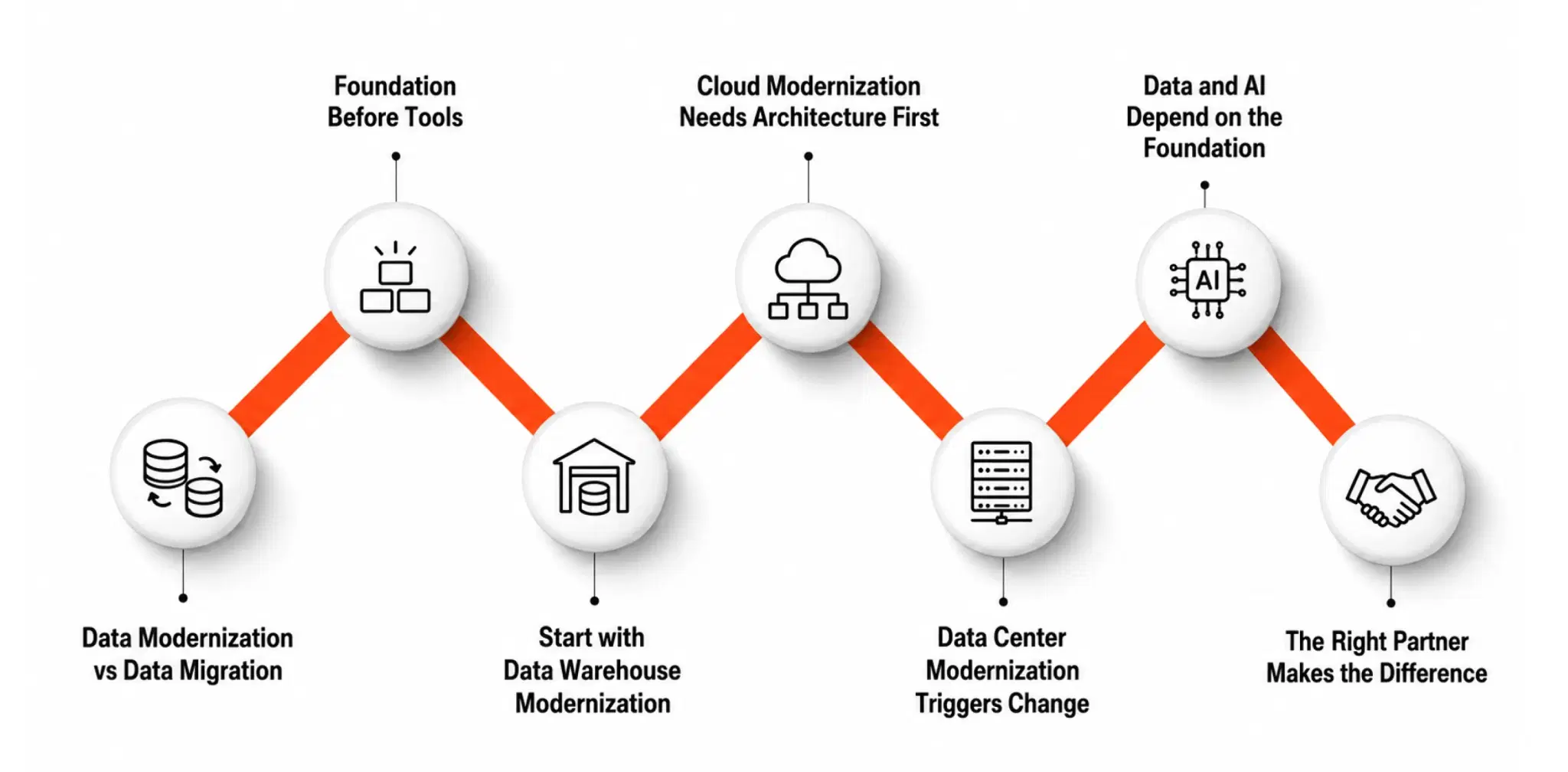
1. Data Modernization Is Not the Same as Data Migration
This distinction matters more than most people realize at the start. Data migration moves data from one location to another. It is a defined, time bound activity. Data modernization services are a broader transformation of how the entire data environment is designed, governed, and used. Migration may be one component of modernization but modernization goes significantly further.
An organization that invests in migration expecting modernization outcomes will be disappointed. The data will be in a new place. It will not be cleaner, better governed, or more useful than it was before.
2. The Foundation Must Come Before the Tools
The most consistent mistake in data modernization programs is selecting the technology before designing the architecture. A platform chosen for its features rather than its fit with the existing data environment creates integration problems that compound with every additional system connected to it. Architecture is the blueprint for how data moves, lives, and stays governed across the organization. Without it, every technology decision is made in isolation.
Before any platform is selected, the organization needs a clear picture of where data currently lives, how it flows between systems, where quality breaks down, and what the business needs the modernized environment to actually do. An effective way to get that clarity is a formal data assessment or engaging data lake consulting services that focus on strategy before tools.
3. Data Warehouse Modernization Services Are the Most Common Starting Point
For most organizations the data warehouse is where the modernization conversation begins. Legacy data warehouses built on monolithic on premises architectures cannot support the query speeds, data volumes, or real time analytical requirements of modern business. Data warehouse modernization services replace or rebuild these environments on platforms like Snowflake, Databricks, BigQuery, or Azure Synapse — with architecture designed for the analytics use cases the organization actually needs rather than the ones it had when the warehouse was originally built.
The critical decision at this stage is not which platform to choose. It is whether the data model and governance framework being built around the new platform are designed for the business outcomes the organization needs to achieve — not just for technical performance.
4. Cloud Data Modernization Services Require Architecture Decisions Upfront
Moving to the cloud is not the same as modernizing in the cloud.
Cloud data modernization services that simply lift and shift existing data environments to cloud infrastructure produce cloud hosted versions of the same problems. The cost may be lower. The speed may be higher. The fundamental data quality, governance, and integration problems remain.
Genuine cloud data modernization services redesign the data architecture for the cloud environment — taking advantage of scalability, real time processing, and the AI and machine learning capabilities that cloud native platforms enable. This requires architecture decisions to be made before migration begins, not discovered during it.
The question to ask before any cloud modernization engagement is whether the provider is designing the architecture first or migrating first and designing later.
5. Data Center Modernization Services Are Often the Trigger
For many organizations data center modernization services are the event that forces the broader modernization conversation.
A data center reaching end of life, a contract expiring, or an infrastructure cost that has become unsustainable creates a window where the organization must decide: do we replicate what we have in a new environment, or do we use this moment to modernize what we have at the same time?
Organizations that replicate miss the opportunity. Organizations that modernize at the same time as they migrate infrastructure arrive at the other end with a data environment that is both current and fit for purpose. The cost difference between the two approaches at execution time is smaller than most people expect. The outcome difference over the following three to five years is significant.
6. Data and AI Solutions Depend Entirely on the Foundation Beneath Them
This is the most important thing to understand before starting a data modernization program. Every data and AI solutions investment — machine learning models, predictive analytics, AI agents, real time decisioning — depends on the quality, consistency, and governance of the data it operates on. AI does not fix bad data. It amplifies it. A model trained on fragmented, inconsistent, or ungoverned data produces outputs that are confidently wrong — which is more dangerous than no AI at all.
Organizations that modernize their data foundation before deploying AI initiatives consistently see better outcomes from those initiatives. Organizations that try to run AI on an unmodernized foundation consistently discover that the AI problem is actually a data problem — at significant cost and after significant time has been lost.
The sequence is not optional. Foundation first. AI second.
7. The Right Partner Makes the Difference
Data modernization services are not a commodity. The difference between a partner who delivers and one who deploys is significant.
A deployment delivers working infrastructure. A delivery produces an environment the business can actually use — with governance built in from the start, data quality addressed at the source rather than patched downstream, and a data foundation that supports the AI and analytics use cases the organization is building toward.
Before selecting a data modernization services partner, ask whether they start with an assessment or a platform recommendation. Ask whether they have a data architecture practice or rely on the technology vendor's architecture. Ask whether they can show reference cases from organizations of comparable size and complexity in your industry. And ask whether their success is measured by your business outcomes or by their delivery milestones.
The answers to those questions will tell you everything you need to know.
Conclusion
Data modernization services done correctly are one of the most valuable investments a business can make. They create the foundation that makes reporting faster, compliance cleaner, and AI initiatives reliable. Done incorrectly — or started in the wrong order — they create expensive infrastructure that the business is left to figure out how to use.
The seven things above are not a checklist to review once. They are the frame through which every decision in a data modernization program should be evaluated. Start with them and the program has a foundation of its own.
Transform your data foundation and connect it to real business outcomes. Talk to our expert today.