Health insurers need more than a place to store data. Claims, eligibility, member, provider, pharmacy, financial and customer information often come from different systems, formats and update cycles. Turning this information into reliable regulatory reports and analytics requires the right architecture as well as the right implementation expertise.
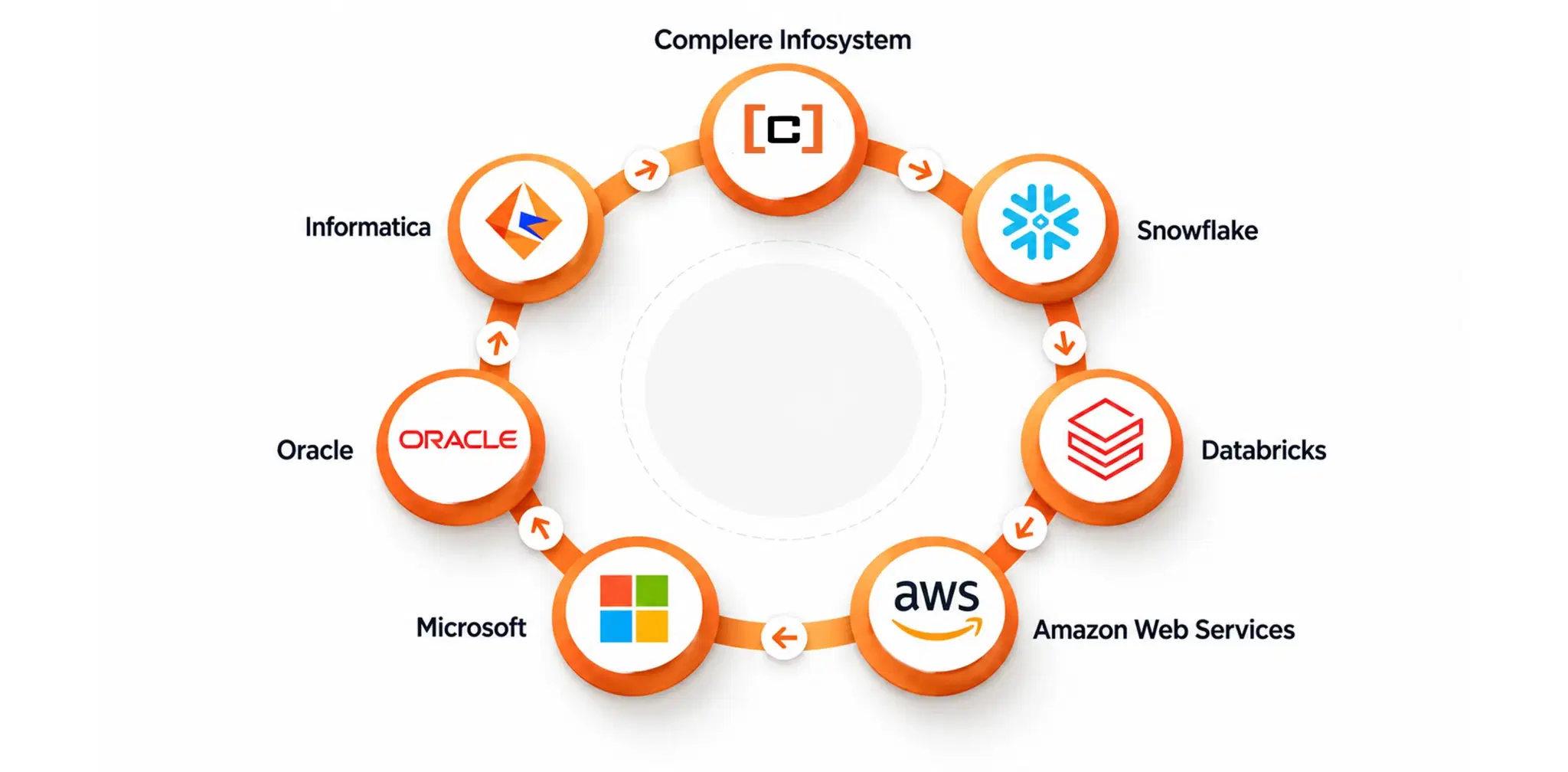
For organizations evaluating health insurance data warehousing, several vendors and partners are relevant, including Complere Infosystem, Snowflake, Databricks, Amazon Web Services (AWS), Microsoft, Oracle and Informatica.
However, they do not solve the same problem. Some provide the underlying data platform, while others focus on implementation, integration, quality or governance. Health insurance technology and analytics leaders should therefore compare them based on claims data integration, regulatory reporting, scalability, governance and analytical requirements.
For organizations evaluating health insurance data warehousing, several vendors and partners are relevant, including Complere Infosystem, Snowflake, Databricks, Amazon Web Services (AWS), Microsoft, Oracle and Informatica.
However, they do not solve the same problem. Some provide the underlying data platform, while others focus on implementation, integration, quality or governance. Health insurance technology and analytics leaders should therefore compare them based on claims data integration, regulatory reporting, scalability, governance and analytical requirements.
Which Data Warehouse Vendors Support Health Insurance Analytics?
The following companies are worth considering for different health insurance data requirements:
| Company | Focus |
|---|---|
| Complere Infosystem | Health insurance data engineering, claims data integration and warehouse implementation |
| Snowflake | Cloud data warehousing, payer analytics and governed data sharing |
| Databricks | Large-scale data engineering, Lakehouse and advanced analytics |
| AWS | Flexible cloud infrastructure and healthcare payer data services |
| Microsoft | Healthcare data integration, Fabric analytics and enterprise reporting |
| Oracle | Health insurance applications, warehousing and analytics |
| Informatica | Data integration, quality, metadata and governance |
The best choice depends on whether the insurer needs a technology platform, implementation partner or both.
What Should Health Insurers Expect from a Data Warehousing Vendor?
A health insurance data warehousing solution should help create reliable analytical information from multiple payer data sources.
The evaluation should go beyond storage capacity. A suitable vendor or implementation partner should be assessed across five areas.
The evaluation should go beyond storage capacity. A suitable vendor or implementation partner should be assessed across five areas.
1. Claims data integration
Claims information may need to be combined with member, eligibility, provider, pharmacy, authorization and financial data.
The architecture should support relevant formats and integration mechanisms, which can include X12 transactions, FHIR, APIs, databases and files.
The architecture should support relevant formats and integration mechanisms, which can include X12 transactions, FHIR, APIs, databases and files.
2. Regulatory reporting
A regulatory reporting environment should make important numbers explainable and traceable.
Ideally, teams should be able to follow:
Source → Integration → Transformation → Data Quality → Warehouse → KPI → Regulatory Report
If this path is unclear, investigating reporting differences can become difficult.
Ideally, teams should be able to follow:
Source → Integration → Transformation → Data Quality → Warehouse → KPI → Regulatory Report
If this path is unclear, investigating reporting differences can become difficult.
3. Scalable data warehouse architecture
Claims history can create very large datasets. A scalable data warehouse should handle increasing data volumes, users, and analytical workloads without requiring the entire architecture to be redesigned.
4. Health insurance analytics
The warehouse should support more than scheduled reporting. Depending on business requirements, health insurance analytics may include claims, trends, utilization, provider analysis, membership, cost analysis, and operational performance.
5. Customer analytics
Combining member and interaction information can also support customer analytics, such as understanding engagement patterns, service interactions, and member journeys. Access to sensitive information must remain governed according to applicable privacy and security requirements.
Data Warehousing Vendors to Consider for Health Insurance Analytics
The companies below are compared by capability rather than presented as an absolute ranking.
1. Complere Infosystem
Best considered for: Health insurance data engineering, integration and warehouse implementation.
Complere Infosystem differs from the technology vendors in this list because it acts as a data engineering and implementation partner rather than providing a proprietary warehouse platform.
Complere Infosystem differs from the technology vendors in this list because it acts as a data engineering and implementation partner rather than providing a proprietary warehouse platform.
Its data warehouse consulting work covers architecture, data pipelines, data modelling, quality and governed access. For health insurance environments, implementation expertise becomes particularly relevant when claims and related payer information must be integrated across multiple systems.
Complere works with platforms such as Databricks, Snowflake, Azure and AWS, allowing the underlying technology to be selected according to the insurer's architecture rather than requiring one proprietary warehouse.
Key strengths:
| Component | What It Does |
|---|---|
| Data warehouse architecture and implementation | Implementation and architecture services |
| Claims and payer data engineering | Claims-focused data engineering |
| Data integration | Integrating multiple sources |
| Data quality | Ensuring quality controls |
| Reporting data models | Designing reporting models |
| Multi-platform implementation | Works across Databricks, Snowflake, Azure, AWS |
| Governance support | Governance and access support |
Consideration: Complere provides implementation and consulting expertise rather than the underlying cloud warehouse product. It is therefore more accurately compared as an implementation partner working alongside platform vendors.
2. Snowflake
Best considered for: Cloud data warehousing, payer analytics and governed data sharing.
Snowflake provides capabilities specifically for healthcare payers. Its platform can unify data across source systems and support analytical use cases using structured and unstructured healthcare information.
Snowflake provides capabilities specifically for healthcare payers. Its platform can unify data across source systems and support analytical use cases using structured and unstructured healthcare information.
Snowflake identifies Member 360 as a payer use case and supports combining claims and other health data. Its broader insurance offering also identifies claims management, customer views and regulatory reporting as use cases.
Key strengths:
| Component | What It Does |
|---|---|
| Cloud-native data warehousing | Core platform capability |
| Healthcare payer capabilities | Payer-specific features |
| Governed data sharing | Secure sharing features |
| Claims analytics | Claims-focused analytics |
| Customer and member views | Member 360 and customer views |
| Security and governance | Security features |
| Scalable analytics | Scalable analytics capabilities |
Consideration: A platform does not automatically establish an insurer's KPI definitions, quality rules or regulatory mappings. These still require appropriate implementation and governance.
3. Databricks
Best considered for: High-volume data engineering, Lakehouse architecture, and advanced analytics.
Databricks provides a Lakehouse approach that can combine traditional data warehousing workloads with large-scale engineering, data science, and AI. This can be relevant where claims and other insurance datasets require substantial processing before they become usable for reporting and analytics. Databricks also supports migration of enterprise data warehouse workloads into a Lakehouse, allowing data engineers, analysts and data scientists to work against common governed data.
Databricks provides a Lakehouse approach that can combine traditional data warehousing workloads with large-scale engineering, data science, and AI. This can be relevant where claims and other insurance datasets require substantial processing before they become usable for reporting and analytics. Databricks also supports migration of enterprise data warehouse workloads into a Lakehouse, allowing data engineers, analysts and data scientists to work against common governed data.
Key strengths:
| Component | What It Does |
|---|---|
| Large-scale data engineering | High-volume processing |
| Lakehouse architecture | Combines lake and warehouse |
| SQL analytics | SQL-based analytics |
| Batch and streaming workloads | Supports both workloads |
| Advanced analytics | Data science and AI capabilities |
| Governance | Governance features |
| Scalable processing | Scales processing |
Consideration: Health insurance data models, regulatory rules and payer-specific transformations still need to be designed and implemented.
4. Amazon Web Services (AWS)
Best considered for: Flexible cloud architecture and broad healthcare payer workloads.
AWS provides a range of services that can be combined to build data lakes, warehouses, integration pipelines, and analytical environments. AWS also has a healthcare payer offering covering areas such as eligibility, claims processing and member engagement. This flexibility allows insurers to build an architecture around their existing applications and data requirements.
AWS provides a range of services that can be combined to build data lakes, warehouses, integration pipelines, and analytical environments. AWS also has a healthcare payer offering covering areas such as eligibility, claims processing and member engagement. This flexibility allows insurers to build an architecture around their existing applications and data requirements.
Key strengths:
| Component | What It Does |
|---|---|
| Data lake and warehouse options | Multiple storage and warehouse services |
| Claims processing ecosystem | Services for claims workflows |
| Data integration | Integration services |
| Healthcare payer capabilities | Payer-specific offerings |
| Scalable infrastructure | Scalable cloud infrastructure |
| Analytics and AI | Analytics and AI services |
| Security services | Security capabilities |
Consideration: AWS provides many individual building blocks rather than one predefined payer warehouse. This makes architecture and governance decisions especially important.
5. Microsoft
Best considered for: Organizations using Microsoft Fabric, Azure, and Power BI.
Microsoft Fabric combines data integration, engineering, warehousing, analytics, and business intelligence within a common data environment. Microsoft's healthcare data solutions can work with claims and other healthcare information, while Fabric Data Warehouse provides an enterprise-scale relational warehouse suited to curated data marts and governed semantic models.
Microsoft Fabric combines data integration, engineering, warehousing, analytics, and business intelligence within a common data environment. Microsoft's healthcare data solutions can work with claims and other healthcare information, while Fabric Data Warehouse provides an enterprise-scale relational warehouse suited to curated data marts and governed semantic models.
Key strengths:
| Component | What It Does |
|---|---|
| Data integration and engineering | Integration and engineering tools |
| Fabric Data Warehouse | Enterprise-scale relational warehouse |
| Healthcare data transformations | Transformations for healthcare data |
| Claims data capabilities | Claims-focused features |
| Power BI integration | BI and reporting integration |
| Enterprise reporting | Enterprise reporting support |
| Scalable analytics | Scalable analytics capabilities |
Consideration: Microsoft announced changes to the delivery model for healthcare data solutions in Fabric in 2026. New implementations should therefore review Microsoft's current deployment and lifecycle documentation before selecting the architecture.
6. Oracle
Best considered for: Health insurers already using Oracle insurance applications and databases.
Oracle combines insurance applications with database, warehousing, Lakehouse, cataloging, and analytics technologies. This can be useful when an insurer wants to consolidate operational insurance information for reporting and analytical workloads within an existing Oracle environment.
Oracle combines insurance applications with database, warehousing, Lakehouse, cataloging, and analytics technologies. This can be useful when an insurer wants to consolidate operational insurance information for reporting and analytical workloads within an existing Oracle environment.
Key strengths:
| Component | What It Does |
|---|---|
| Health insurance applications | Operational insurance applications |
| Data warehousing | Warehousing capabilities |
| Data integration | Integration tools |
| Analytics | Analytics features |
| Data cataloguing | Cataloging and metadata |
| Enterprise reporting | Reporting capabilities |
Consideration: Insurers with heterogeneous or multi-cloud environments should assess integration complexity alongside functionality.
7. Informatica
Best considered for: Integration, data quality and governance across complex environments.
Informatica is particularly relevant when the biggest obstacle to health insurance analytics is not storage, but inconsistent information coming from multiple source systems. Its capabilities cover integration, data quality, metadata, lineage, master data and governance.
Informatica is particularly relevant when the biggest obstacle to health insurance analytics is not storage, but inconsistent information coming from multiple source systems. Its capabilities cover integration, data quality, metadata, lineage, master data and governance.
Key strengths:
| Component | What It Does |
|---|---|
| Claims data integration | Integration for claims |
| Data quality | Quality controls and cleansing |
| Metadata management | Metadata capabilities |
| Data lineage | Lineage tracking |
| Master data | Master data management |
| Data governance | Governance tools |
Consideration: Informatica is commonly used with a warehouse or Lakehouse platform rather than serving as the primary analytical warehouse itself.
How Do Health Insurance Data Warehousing Vendors Compare?
| Company | Primary Strength | Best Fit |
|---|---|---|
| Complere Infosystem | Implementation and data engineering | Complex payer data integration and warehouse implementation |
| Snowflake | Cloud data warehousing | Payer reporting, analytics and governed sharing |
| Databricks | Lakehouse and engineering | High-volume processing and advanced analytics |
| AWS | Cloud ecosystem | Flexible and scalable payer architectures |
| Microsoft | Integrated analytics ecosystem | Fabric, Azure and Power BI environments |
| Oracle | Insurance applications + data platform | Existing Oracle environments |
| Informatica | Integration and governance | Data quality and multi-source integration |
This comparison reflects different roles in the data ecosystem and is not an independent ranking of product quality.
How Should Health Insurers Choose a Data Warehousing Partner?
- Start with the data sources
Document claims, eligibility, member, provider, pharmacy, finance and customer systems before evaluating vendors. A platform demonstration is less useful if it does not address the insurer's actual integration landscape. - Test claims data integration
Ask the vendor to explain how claims move from source systems into curated analytical datasets. Evaluate transformations, validation, reconciliation, error handling and lineage—not simply ingestion speed. - Test regulatory traceability
Select an important regulatory KPI and ask:
Can this number be traced back to its original records and transformation rules? This provides a practical test of architecture's auditability. - Evaluate scalability
A scalable data warehouse should support increasing claims history, additional source systems, more users and new analytical workloads without frequent redesign. - Evaluate business definitions
Check whether KPIs and measures are centrally defined. A technically strong platform can still produce conflicting reports if different teams calculate membership, claims, or utilization of metrics differently. - Separate platform selection from implementation expertise
This distinction is important.
Snowflake, Databricks, AWS, Microsoft and Oracle provide technology foundations.
Implementation partners can design data models, build integrations, establish quality controls, and translate payer reporting requirements into working data pipelines.
A health insurer may therefore need both.
What Does a Scalable Health Insurance Data Warehouse Look Like?
A simplified architecture is:
Claims | Members | Eligibility | Providers | Pharmacy | Customer Data
↓
Claims Data Integration
X12 | FHIR | APIs | Databases | Files
↓
Data Quality & Reconciliation
↓
Governance, Metadata & Lineage
↓
Scalable Data Warehouse / Lakehouse
Claims | Members | Eligibility | Providers | Pharmacy | Customer Data
↓
Claims Data Integration
X12 | FHIR | APIs | Databases | Files
↓
Data Quality & Reconciliation
↓
Governance, Metadata & Lineage
↓
Scalable Data Warehouse / Lakehouse
↓
Governed Business & KPI Layer
↓
Regulatory Reporting | Health Insurance Analytics | Customer Analytics
Governed Business & KPI Layer
↓
Regulatory Reporting | Health Insurance Analytics | Customer Analytics
This architecture separates ingestion, quality, governance, and business definitions rather than placing all reporting logic inside dashboards.
Final Takeaway
Selecting among data warehousing vendors for health insurance should begin with the insurer's data problems, not with a product feature list. For technology and analytics leaders, one of the most useful questions is:
Can we trace a claims or regulatory KPI from the final report through its business definition, transformations and quality controls back to the original source?
Complere Infosystem, Snowflake, Databricks, AWS, Microsoft, Oracle and Informatica address different parts of this challenge. The right combination should create a health insurance data warehousing environment that can integrate complex payer data, scale with analytical demand and provide trusted information for regulatory reporting, health insurance analytics and customer analytics.
See what a connected, governed data environment could look like for your health insurance operations.